
What We Look For When a Homeowner Says “It Just Started Happening”
It Usually Starts With a Sentence
Most service calls don’t start with a clear problem.
They start with a sentence.
“It just started happening.”
“It wasn’t doing this before.”
“It’s probably nothing, but…”
At Apex Roofing, those calls are familiar. And more often than not, by the time a homeowner notices something, the issue has already been developing for a while. Not in a dramatic way. Slowly. Quietly. The kind of change that doesn’t stand out until it crosses a threshold.
What We Notice Before We Ever Climb a Ladder
When we pull up to a house, we are not just looking for damage. We are looking for patterns.
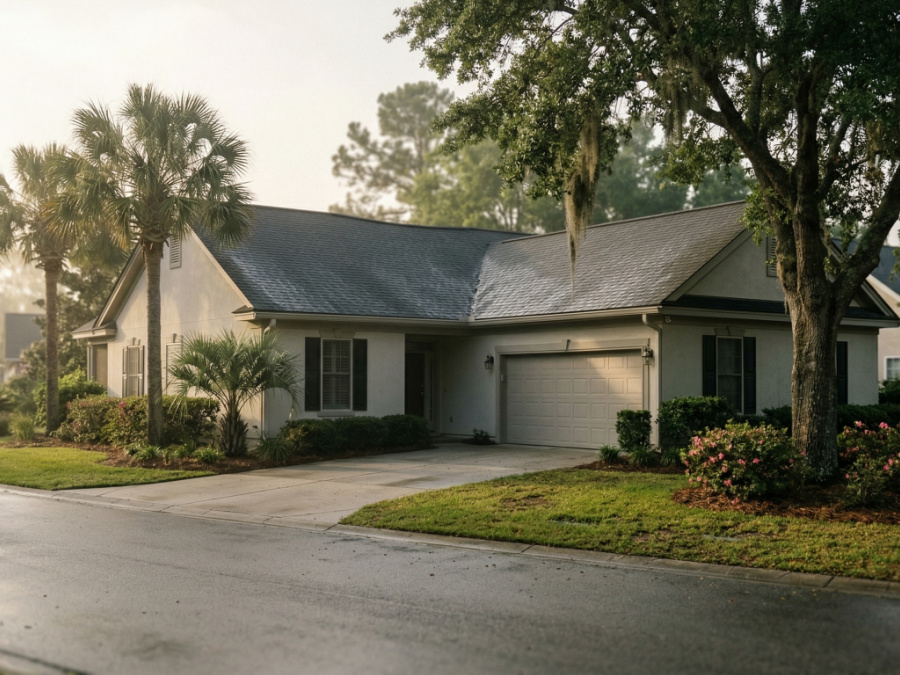
The first thing we do is step back and take in the structure as a whole. From the ground, small inconsistencies begin to show themselves. A roofline that is not quite as straight as it should be. A section that holds moisture a little longer after rain. Areas where debris collects more heavily than expected. None of these things confirm a problem on their own, but together they start to point in a direction.
Following the Path Water Takes
From there, we start working through the system the way water does.
We look at how it moves across the roof, how it transitions through flashing and valleys, and how it exits through the gutter system. If water is not moving cleanly, something has changed. That change might be subtle, but it rarely stays contained. Water does not stop at the first weak point. It continues, finding the next place where the system gives it an opportunity.
In many cases, what a homeowner notices inside the house is several steps removed from where the issue actually started.
Why Surface Fixes Miss the Real Problem
That is why surface-level fixes tend to miss the mark. Patching what is visible does not correct what is driving the behavior underneath. The system adapts just enough to keep functioning, but it does so under stress.
The Same Pattern Shows Up in Other Systems
We see the same pattern outside of roofing as well.
Professionals in other trades describe nearly identical situations. Garage door technician Maxim Geht of Ohio Garage Door Repair, located in North Olmstead, OH, explained it in a way that lines up closely with what we see on the roofing side.
“Structural stress is rarely an isolated event. Just as a dipping roofline indicates a shift in the home’s structure, a garage door that starts to track unevenly or chatter is usually telling you that the springs are fatiguing or the house is settling. In both industries, if you wait for the catastrophic snap, you have already missed the most affordable window for a fix.”
Different system, same behavior. Something shifts slightly. The system compensates. The signs are there, but they are easy to dismiss because everything still appears to be working.
What We Find Once We’re On the Roof
Back on the roof, those early signs often show up in materials before they show up inside the home. Shingles begin to lose integrity in specific areas. Flashing starts to separate at transition points. Seals around penetrations weaken just enough to allow moisture to linger. None of it looks urgent, but it is all connected.
What matters is not just what we find, but how long it has been happening.
How You Can Tell It’s Been There a While
There is a difference between a recent issue and one that has been developing over time. You can usually tell by how far the pattern has spread. A localized problem behaves differently than one that has been allowed to move through multiple parts of the system.
This is where experience changes the outcome. When you have seen enough of these situations, you stop looking at problems as isolated events. You start recognizing sequences.
How Small Issues Turn Into Bigger Ones
A homeowner notices a stain. That leads to a closer look at the roof. That reveals a drainage issue. That traces back to a subtle shift in how water has been moving for months. Each step connects to the next.
The longer that sequence is allowed to play out, the more complex the solution becomes.
Why South Carolina Homes Are More Exposed
In South Carolina, the environment adds another layer. Moisture is not occasional. It is constant. Humidity, rain, and heat work together to accelerate whatever is already in motion. A small weakness does not stay small for long under those conditions.
But the environment is not the cause. It is the amplifier.
The Real Problem Is Timing
The root of the issue is almost always the same. Something changed, and it was not addressed early.
By the time a homeowner says “it just started happening,” the system has usually been adjusting for a while. The visible symptom is just the point where it became noticeable.
The Bottom Line
That is why the most effective approach is not just fixing what is in front of you. It is understanding how it got there.
A roof does not fail all at once. It moves through stages. Subtle shifts, early stress, visible signs, and eventually, failure. The goal is to step in before that final stage.
The difference between a simple repair and a larger structural issue is rarely about luck. It comes down to timing and whether those early patterns were recognized for what they were.
Because in most cases, the system was giving you the answer long before the problem forced the question.