
How Long Does a Roof Last in Hilton Head’s Humidity and Salt Air?
Quick Answer:
In the Hilton Head area, asphalt shingle roofs typically last 15 to 25 years, standing seam metal roofs typically last 40 to 60 years, and slate or tile roofs can exceed a century — with real-world results usually landing below the high end of national averages because coastal humidity, salt air, and hurricane exposure add stress inland roofs don’t face. Material matters, but installation quality, attic ventilation, and proximity to open water or tidal marsh often affect real-world lifespan more than age alone. Apex Roofing inspects roofs throughout Hilton Head Island, Sea Pines, Palmetto Dunes, and the surrounding Lowcountry to determine actual remaining service life rather than relying on a general estimate.
Most homeowners eventually ask the same question after living on Hilton Head Island for several years: How long should my roof actually last in this climate? It’s a fair question because coastal South Carolina places very different demands on a roof than many inland areas. Neighbors sometimes replace roofs years apart even though their homes were built at the same time, and that often leads homeowners to wonder whether the island’s humidity and salt air are shortening the life of every roof.
The truth is that roofs don’t age according to the calendar alone. They age according to the conditions they experience every day. A roof in Hilton Head is exposed to intense sunshine, year-round humidity, salt carried inland from the Atlantic, frequent thunderstorms, and hurricane-force winds that can gradually reduce its ability to protect a home. Understanding how those conditions affect a roofing system is far more valuable than relying on a general lifespan estimate.
Roof Lifespan by Material: National Average vs. Hilton Head’s Coastal Climate
The table below compares typical U.S. lifespan ranges against realistic Hilton Head-adjusted ranges. These are industry-standard estimates, not a guarantee for any specific roof — actual lifespan still depends on installation quality, ventilation, maintenance history, and how close a home sits to open water.
| Material | Typical U.S. Lifespan | Typical Lifespan in Hilton Head’s Coastal Climate | Why It Differs Locally |
| 3-tab asphalt shingles | 15 to 20 years | 12 to 18 years | UV exposure and salt-accelerated seal-strip and fastener wear shorten the lower end of the range |
| Architectural (dimensional) asphalt shingles | 25 to 30 years | 18 to 25 years | Heavier and more wind-resistant than 3-tab, but coastal humidity and salt air still trim years off inland averages |
| Standing seam metal (concealed fastener) | 40 to 70 years | 40 to 60 years | Performs well near the coast when the alloy and coating are matched to salt exposure; concealed fasteners avoid the corrosion point that limits exposed-fastener panels |
| Exposed-fastener metal panels | 20 to 30 years | 15 to 25 years | Exposed fasteners are the weak point — salt air can accelerate their corrosion well before the panels themselves fail |
| Slate / clay or concrete tile | 50 to 100+ years | 50 to 100+ years | Less affected by salt directly, but weight and cost make these uncommon choices for most Hilton Head homes; structural evaluation is required before installation |
A Roof Doesn’t Age One Year at a Time on Hilton Head—It Ages One Season at a Time
One of the biggest misconceptions about coastal roofing is that salt air or humidity suddenly ruins a roof. That’s rarely what happens. Roofs age gradually, with every season contributing a little more wear until years of exposure finally begin affecting performance.
Summer sunshine plays a larger role than many homeowners realize. Ultraviolet light slowly dries the asphalt that gives architectural shingles their flexibility. As shingles become less flexible, they are less able to bend during strong winds. Instead of flexing and resealing properly, aging shingles are more likely to crack, lift, or lose their protective granules. By the time shingles begin blowing off during a tropical storm, much of that deterioration has already taken place over many years.
Humidity creates a different challenge. High moisture levels don’t typically destroy shingles by themselves, but they keep roofing materials damp for longer after rainstorms. Flashing, sealants, exposed fasteners, and roof penetrations remain wet longer than they would in a drier climate, increasing the opportunity for gradual deterioration. Warm summer nights also slow the drying process, meaning moisture often lingers well after a storm has passed.
Salt air adds another layer of stress, particularly for homes closer to the shoreline or tidal waterways. Contrary to popular belief, salt doesn’t usually “eat” asphalt shingles. Instead, it accelerates corrosion on exposed metal components such as flashing, drip edge, fasteners, pipe boots, and roof penetrations. Those components are critical to keeping water out, and when corrosion gradually weakens them, the roofing system becomes more vulnerable to leaks even if the shingles still appear to be in good condition.
Why Two Roofs Installed the Same Year Can Have Completely Different Lifespans
Perhaps the most important thing homeowners should understand is that two roofs installed on the same day can reach the end of their service lives years apart.
We’ve seen homes throughout Sea Pines, Palmetto Dunes, Hilton Head Plantation, Indigo Run, Wexford, and Long Cove where neighboring roofs of the same age perform very differently. One roof may continue protecting the home exceptionally well because it was properly installed, receives adequate attic ventilation, and has been inspected regularly. Another may require replacement much sooner because repeated repairs, poor flashing installation, inadequate ventilation, or years of deferred maintenance have steadily reduced its remaining service life.
Environmental exposure also varies throughout the island. Homes closer to the Atlantic Ocean, Calibogue Sound, Broad Creek, Skull Creek, or tidal marshes generally experience greater salt exposure than properties located farther inland. Dense tree canopy in communities such as Sea Pines or Hilton Head Plantation can leave roofs shaded longer after storms, allowing leaves, pine needles, and organic debris to trap moisture against roofing materials. Large custom homes with multiple rooflines, valleys, dormers, skylights, and architectural features naturally have more transitions where flashing must perform perfectly year after year.
This is why comparing your roof to your neighbor’s rarely provides a reliable answer. Roof lifespan is determined by the condition of the entire roofing system, not simply the date it was installed.
Most Roof Problems Begin Long Before Homeowners Notice Them
One reason homeowners are often surprised by roof failures is that deterioration usually starts beneath the surface. The roof may still look perfectly acceptable from the driveway while several important components are quietly reaching the end of their useful life.
Seal strips that once held shingles together gradually lose adhesion after years of heat and weather exposure. Fasteners slowly loosen through repeated expansion and contraction. Flashing around chimneys, plumbing vents, skylights, and roof-to-wall transitions can begin separating as sealants age. Synthetic underlayment beneath the shingles continues aging even when it isn’t visible. None of these changes are dramatic on their own, but together they reduce the roof’s ability to withstand wind-driven rain during tropical systems.
This explains why many homeowners say things like, “It only leaks during hurricanes,” or “It only drips when the rain is blowing sideways.” Those aren’t random events. They’re often signs that the roofing system has developed small weaknesses that ordinary rainfall doesn’t expose. Severe weather simply places more stress on those vulnerable areas until water finally finds its way inside.
Understanding this progression changes how homeowners think about roof replacement. You’re not replacing a roof because one shingle curled or one ceiling stain appeared. You’re evaluating whether years of gradual aging have reduced the roof’s ability to continue protecting your home reliably.
Manufacturer Warranties Don’t Predict Real-World Roof Life
Another common misunderstanding is believing that a manufacturer’s warranty tells you exactly how long your roof will last. While warranties are valuable, they shouldn’t be confused with expected service life.
A warranty addresses specific manufacturing conditions under defined terms. It doesn’t prevent ultraviolet exposure, repeated hurricanes, poor attic ventilation, improper installation, salt-related corrosion, or years of environmental aging from affecting how the roofing system performs. Two identical roofing products installed on different homes can experience very different lifespans simply because their environments, maintenance histories, and installation quality are different.
This is one reason insurance companies increasingly ask about roof age while also considering overall condition. Age provides context, but condition determines performance. A well-maintained roof with healthy flashing, secure fasteners, effective ventilation, and limited storm damage may continue performing reliably, while another roof of the same age could already be approaching replacement.
Rather than asking whether your warranty is still active, the better question is whether your roofing system continues performing the way it was designed to perform.
Vacation Homes Often Face Different Roofing Challenges
Hilton Head has thousands of second homes, vacation properties, and short-term rentals, and these homes often experience roofing issues differently than primary residences.
A family living in their home year-round is likely to notice a ceiling stain, a drip during heavy rain, or shingles scattered across the yard soon after a storm. Owners of seasonal properties may not return for weeks or months after severe weather passes. During that time, a relatively small roof leak can quietly saturate insulation, damage roof decking, stain drywall, and create conditions for mold growth before anyone realizes there’s a problem.
Property managers do an excellent job monitoring many vacation homes, but even professionally managed properties benefit from regular roof inspections before and after hurricane season. Discovering minor flashing damage early is almost always less expensive than repairing widespread interior water damage later.
The Best Way to Measure Roof Life Is Through Professional Evaluation
One of the biggest mistakes homeowners make is trying to estimate roof condition from the ground. While missing shingles or visible sagging are obvious warning signs, many of the factors that determine remaining service life simply can’t be evaluated without getting on the roof.
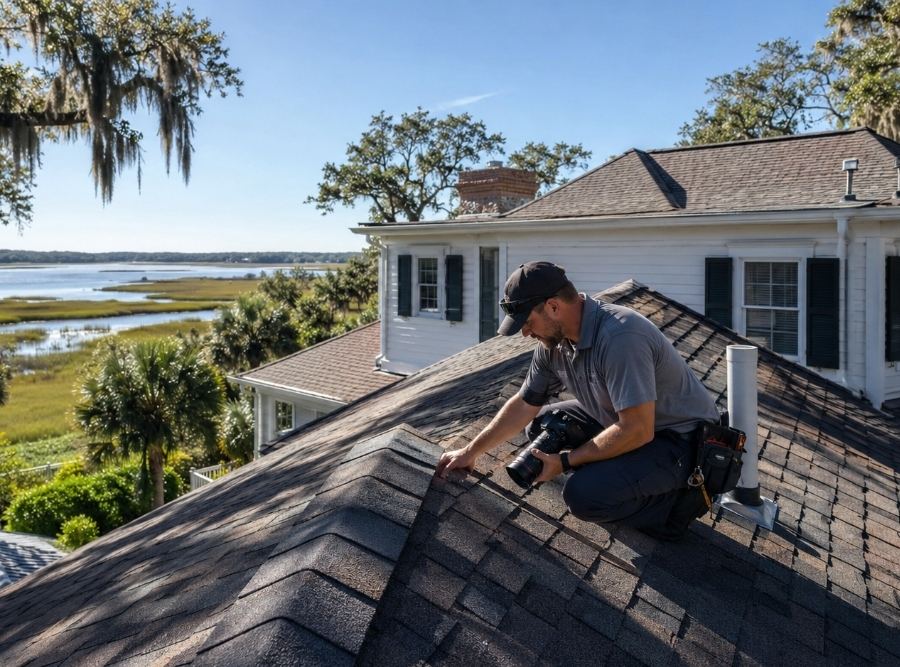
At Apex Roofing, Ralph or Pierce personally inspect every roof because understanding its condition requires more than a quick visual estimate. We evaluate shingles, flashing, fasteners, ridge caps, valleys, roof penetrations, ventilation, underlayment exposure, and other components that work together as a complete roofing system. Our goal isn’t simply to identify today’s problems—it’s to understand how the roof is likely to perform during future storms and explain our findings in a way homeowners can confidently understand.
When replacement is the right recommendation, our process reflects the same attention to detail. We provide itemized written estimates before work begins, obtain required permits through Beaufort or Jasper County, document every stage of the project with photographs, perform a magnetic sweep after installation to collect stray fasteners, register manufacturer warranties upon completion, and finish with a final walkthrough because we believe homeowners deserve complete transparency from start to finish.
Stop Asking How Old Your Roof Is. Start Asking How Healthy It Is.
The question isn’t whether your roof has reached a certain birthday. The question is whether it still has the structural integrity and weather resistance to protect your home through another season of coastal weather.
Some Hilton Head roofs continue performing exceptionally well after decades because they were properly installed, well ventilated, and consistently maintained. Others require replacement much sooner because years of environmental exposure, deferred maintenance, repeated storm damage, or installation deficiencies have gradually reduced their ability to withstand the island’s climate. The difference isn’t luck—it’s the condition of the roofing system.
If you’ve started noticing granules collecting in your gutters, rust around flashing, recurring repairs, water stains after tropical storms, or you’re simply unsure how much life your roof has left, an inspection can provide clarity before small problems become expensive ones. Replacing a roof should never be based on guesswork or comparison with neighboring homes. It should be based on a clear understanding of how your roof has aged and how much reliable service it can still provide.
Frequently Asked Questions About Roof Lifespan on Hilton Head
How long do architectural shingles last on Hilton Head?
Architectural asphalt shingles typically last 25 to 30 years nationally, but on Hilton Head, coastal UV exposure, humidity, and salt-driven wear on seal strips and fasteners usually bring real-world results closer to 18 to 25 years. Homes with good attic ventilation, quality installation, and regular inspections tend to land at the higher end of that range, while homes with deferred maintenance or poor ventilation often fall short of it.
Does salt air affect metal roofing lifespan?
Yes, but salt air affects metal roofing differently than it affects shingles — it accelerates corrosion at fasteners, seams, and cut edges rather than degrading the panel material itself. Concealed-fastener standing seam systems generally hold up better near the coast than exposed-fastener panels, since exposed fasteners are the first point where salt-driven corrosion typically appears. With an alloy and coating matched to coastal exposure, a standing seam metal roof on Hilton Head can still realistically reach 40 to 60 years.
What shortens roof life in the South Carolina Lowcountry?
The biggest factors are intense UV exposure that dries out asphalt shingles, humidity that keeps roofing materials damp longer after storms, salt air that corrodes flashing and fasteners, and wind-driven rain from tropical storms that exposes weaknesses in aging seals and flashing. Poor attic ventilation and deferred maintenance compound all of these factors, which is why two roofs of the same age and material can age very differently depending on installation quality and upkeep.
How often should I inspect a roof near the ocean?
Homes closer to the Atlantic, tidal creeks, or open marsh generally benefit from an annual roof inspection, plus a check after any major storm or hurricane, since salt exposure accelerates corrosion of flashing and fasteners faster than it affects roofs farther inland. Homes set back from open water can often follow a slightly longer inspection interval, but every roof on Hilton Head benefits from a professional look before and after hurricane season regardless of distance from the coast.
Not Sure How Much Life Is Left in Your Roof?
If you’re unsure how your roof is holding up against Hilton Head’s humidity and salt air, Apex Roofing of the Lowcountry offers professional roof inspections throughout Hilton Head Island, Sea Pines, Palmetto Dunes, and the surrounding communities. Learn more about our roof inspection services, or ask about metal roofing if you’re considering a longer-lasting replacement option for your next reroof.

Ralph Brehany is the owner and president of Apex Roofing of the Lowcountry, a licensed residential roofing contractor he founded alongside his son, Pierce, serving Bluffton, Hilton Head Island, Beaufort, and the surrounding Lowcountry. The company is CertainTeed ShingleMaster certified and holds SC License #57706, handling roof repair, replacement, and new installation across Beaufort and Jasper County. Ralph is known for staying hands-on throughout every project, from the initial estimate to daily progress updates on site.