
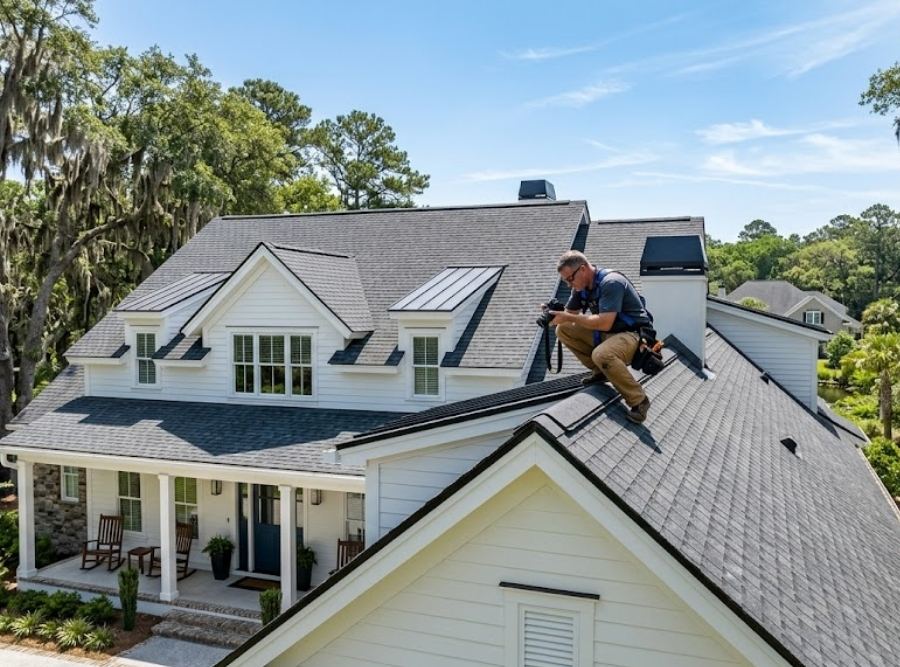
Roofing contractor inspecting architectural shingle roof on a luxury Lowcountry home in Bluffton, SC.

How Do I Know If My New Construction Roof Was Installed Correctly?

Quick Answer:
A new construction roof should have straight, consistent shingle lines, properly installed flashing, secure ridge caps, and no signs of leaks, lifted shingles, exposed nails, or uneven roof planes. If you notice anything that doesn’t look right or your builder tells you “it’s normal” without a clear explanation—an independent roof inspection can help determine whether the roof was installed correctly before your builder warranty expires.

Buying a newly built home comes with a certain level of confidence. Everything is supposed to be new, modern, and built to current standards. That expectation naturally extends to the roof. After all, if the home was just completed, most homeowners assume the roofing system should perform flawlessly for years without a second thought.

Then something catches your attention. Maybe the shingle lines don’t appear perfectly straight when you pull into the driveway. Perhaps you notice a loose ridge cap after the first windy afternoon, or a small water stain appears in the attic following one of Bluffton’s heavy summer thunderstorms. You ask the builder, and the response is reassuring: “That’s normal.” Sometimes it truly is. Other times, it’s the beginning of a workmanship issue that deserves a closer look.

One of the biggest misconceptions about new construction is that a brand-new roof cannot have installation problems. In reality, roofing materials rarely fail during the first year. When issues appear on a new home, they are far more likely to be related to workmanship, installation details, scheduling pressures, or overlooked finishing work than defective shingles themselves. Knowing how to recognize the difference between a harmless cosmetic imperfection and a legitimate roofing concern can save homeowners significant frustration, help preserve builder warranty rights, and prevent small problems from developing into costly repairs after the warranty period ends.

A New Roof Can Pass Every Inspection and Still Have Workmanship Problems

Many homeowners assume that because a newly built home received its final inspections, every part of the roofing system must have been installed perfectly. While local inspections are an important part of the construction process, they are not intended to serve as detailed quality-control evaluations of every roofing detail or every manufacturer’s installation requirement.

A municipal inspection primarily confirms that construction complies with applicable building codes. Those inspections are essential, but they are different from an independent roofing evaluation focused specifically on workmanship, flashing integration, ventilation, fastening patterns, and overall installation quality. A roof can satisfy minimum code requirements while still containing installation details that deserve attention before they become larger problems.

That distinction becomes especially important in rapidly growing communities throughout Bluffton. Neighborhoods around New Riverside, Buckwalter Parkway, Lawton Station, Hampton Lake, and other expanding areas often see dozens or even hundreds of homes under construction simultaneously. Builders coordinate multiple subcontractors, overlapping schedules, inspections, and tight completion deadlines. The vast majority of new homes are completed successfully, but production schedules can also create situations where small roofing details receive less attention than they deserve. Most of those issues remain hidden until the roof experiences its first season of heavy rain, high humidity, and strong coastal winds.

Understanding that possibility is not about questioning every builder or assuming poor workmanship. It is simply recognizing that a roof is a complex weather protection system made up of many individual components, and each of those components must work together correctly for the roof to perform as intended over the coming decades.

The First Year Is When Hidden Installation Issues Usually Reveal Themselves

One of the most interesting things about roofing systems is that many installation mistakes don’t become visible immediately. A roof may appear perfectly acceptable on the day you receive your keys, yet begin showing subtle warning signs months later as it experiences real weather conditions for the first time.

The Lowcountry provides an ideal testing environment because roofs are exposed to repeated cycles of intense sunlight, high humidity, afternoon thunderstorms, and seasonal tropical weather. Those conditions cause roofing materials to expand, contract, shed water, and resist wind forces in ways they simply cannot while construction is still underway. Small installation shortcuts that remained hidden during dry weather often become much easier to identify after repeated storms and months of thermal movement.

We’ve seen homeowners become concerned after noticing slightly lifted shingle corners, ridge caps beginning to separate, flashing that appears unusually visible, or isolated water stains developing near roof penetrations after heavy rain. In some situations those observations point toward normal settling or harmless cosmetic conditions. In others, they indicate installation details that deserve prompt attention while builder warranty coverage is still available. The important point is that homeowners should not dismiss every concern simply because the roof is new.

Many builders also provide a one-year workmanship warranty, and that timeline passes much faster than most homeowners expect. By the time landscaping is finished, furniture has been purchased, and life begins feeling normal in a new home, months may have already passed. Waiting until the warranty is nearly over before taking a closer look at the roof leaves much less time to identify, document, and resolve legitimate workmanship concerns.

A Roof Can Look Perfect From the Driveway and Still Have Problems

Most homeowners evaluate their roof from ground level because that’s where they naturally see it every day. They look for missing shingles, obvious storm damage, or anything that appears dramatically out of place. While those observations are certainly worthwhile, they reveal only a small percentage of the roofing system.

Some of the most important installation details are almost impossible to evaluate without getting onto the roof. Flashing around plumbing vents may appear perfectly normal from below while leaving small openings that eventually allow water intrusion. Nail placement beneath the shingles can significantly affect wind resistance without creating any visible clues from the street. Starter strips hidden beneath the first course of shingles, properly lapped underlayment, valley construction, ridge vent installation, and fastening patterns all contribute to the roof’s long-term performance even though homeowners never actually see them.

This is one reason we encourage homeowners not to judge a roof solely by appearance. Crooked shingle lines may catch your attention immediately, yet the more significant concern could be a flashing detail hidden behind a chimney or sidewall that cannot be seen without a close inspection. Conversely, a roof that looks slightly uneven in certain lighting conditions may simply reflect natural variations in the roof decking beneath the shingles rather than indicating poor installation. Distinguishing between those situations requires looking at the roofing system as a whole rather than focusing on a single visual detail.

Not Every Imperfection Means the Roof Was Installed Incorrectly

One challenge homeowners face is deciding whether they’re seeing a genuine problem or simply noticing normal characteristics of a newly installed roofing system. Online photographs and social media discussions often make perfectly installed roofs appear unrealistically flawless, creating expectations that don’t always match real-world construction.

Architectural asphalt shingles, for example, are manufactured with dimensional profiles designed to create depth and shadow. Depending on the time of day, the angle of the sun, and the slope of the roof, those shadow lines can sometimes make shingles appear slightly uneven even when they have been installed correctly. Similarly, newly installed shingles may require time and warm weather for their seal strips to fully activate and bond as designed. That process is entirely different from shingles that are lifting because they were improperly fastened or installed.

The key is looking for patterns rather than isolated observations. A single shingle that appears slightly different from its neighbors is rarely as concerning as repeated irregularities across multiple roof sections. Likewise, one visible flashing detail may simply reflect the roof’s design, while widespread gaps around penetrations or multiple exposed fasteners deserve closer attention. Homeowners don’t need to become roofing experts overnight, but understanding that context helps avoid unnecessary worry while still recognizing when an independent inspection makes sense.

The Installation Details That Matter More Than Most Homeowners Realize

When homeowners think about a roof, they naturally focus on the shingles because they’re the most visible part of the system. In reality, shingles are only the outer layer of a much more complex assembly designed to manage water, withstand wind, allow proper ventilation, and protect the structure beneath. A brand-new roof can use premium shingles and still develop problems if the supporting installation details weren’t completed correctly.

Some of the most important components are almost invisible once construction is complete. Starter strips help secure the first course of shingles against wind uplift. Underlayment provides a secondary layer of water protection beneath the finished roof covering. Flashing directs water safely around chimneys, plumbing vents, valleys, dormers, skylights, and roof-to-wall intersections where leaks most commonly develop. Ridge vents and intake ventilation work together to move heat and moisture through the attic, helping protect both the roofing materials and the structure below.

Many of the roofing issues we inspect aren’t caused by defective products at all. They’re the result of small installation details that didn’t receive the attention they deserved. A pipe boot may not have been integrated correctly with the surrounding shingles. Flashing may have been installed in a way that allows wind-driven rain to work behind it. Fasteners may have been placed too high, overdriven, or not secured properly into the roof decking. None of those issues are immediately obvious from the ground, yet each has the potential to affect how the roof performs over the coming years.

This is one reason we encourage homeowners to think of their roof as a complete weather protection system rather than simply a collection of shingles. The visible surface matters, but the craftsmanship beneath and around it often determines whether the roof delivers decades of dependable performance or begins developing problems much sooner than expected.

Bluffton’s First Hurricane Season Is Often the Roof’s First Real Test

A newly completed home may look perfect on the day you move in, but the roof hasn’t yet experienced the conditions it was designed to withstand. Construction often finishes during relatively calm weather, leaving the first major thunderstorms, tropical systems, and hurricane season to become the roof’s first true performance test.

Throughout Bluffton and the surrounding Lowcountry, roofing systems are exposed to environmental conditions that quickly reveal weaknesses. Heavy rain can expose improperly integrated flashing long before homeowners notice any visible ceiling stains. Strong coastal winds test whether shingles, ridge caps, and starter courses were fastened correctly. High humidity repeatedly cycles moisture through attic spaces, making proper ventilation far more important than many homeowners realize. Even the daily expansion and contraction caused by intense summer heat gradually tests how well individual roofing components work together.

We’ve seen situations where a roof appeared completely problem-free until its first significant storm. Only then did homeowners discover water entering around a plumbing vent, flashing detail, or roof penetration that had remained dry throughout construction. In other cases, the first windy weather revealed shingles that hadn’t fully sealed because of installation issues rather than normal curing. Those are exactly the kinds of concerns that are much easier to address early while documentation is readily available and builder warranty timelines remain active.

None of this means homeowners should expect problems after every storm. Most new roofs perform exactly as they should. The point is that Bluffton’s climate naturally exposes workmanship issues more quickly than many other regions, making early observation and timely inspections especially valuable.

When “That’s Normal” Deserves a Second Opinion

Perhaps the most frustrating part of owning a newly built home is trying to decide whether your concerns are justified. Builders hear questions from homeowners every day, and many observations truly are normal characteristics of new construction. At the same time, not every concern should be dismissed simply because the home is brand new.

One phrase homeowners tell us they hear repeatedly is, “That’s normal.” Sometimes it is. Roofing materials naturally settle, seal, and weather during their first months of exposure. Certain visual variations are expected and do not affect performance. The challenge is that homeowners rarely have enough roofing experience to know where normal ends and a legitimate workmanship concern begins.

That’s where an independent inspection can provide tremendous value. Rather than relying on assumptions or conflicting opinions, an experienced roofing professional can evaluate the roof objectively and explain exactly what they’re seeing. Sometimes the best news a homeowner can receive is confirmation that the roof is performing as intended and no corrective work is necessary. Other times, an inspection identifies a relatively minor installation detail that can be corrected before it develops into a much larger issue.

We’ve found that homeowners are rarely looking for someone to criticize their builder. Most simply want clarity. They want to know whether the roof protecting their family’s investment was installed correctly and whether anything deserves attention while builder warranty coverage is still available. That kind of objective guidance often brings far more peace of mind than simply hearing, “Don’t worry about it.”

The One-Year Builder Warranty Passes Faster Than Most Homeowners Expect

For many new construction homes, the first year becomes an important window for identifying workmanship-related concerns. That doesn’t mean every builder provides identical warranty terms, nor does it mean every roofing issue will automatically be covered. Warranty coverage varies, and homeowners should always review the documentation provided by their builder to understand exactly what is included and for how long.

Even so, one pattern appears repeatedly. The first year disappears quickly. Homeowners spend the first several months settling into the house, furnishing rooms, completing landscaping projects, learning the neighborhood, and enjoying their new home. By the time they realize the builder warranty anniversary is approaching, they often haven’t looked closely at the roof since moving day.

Scheduling an independent roof inspection before that milestone gives homeowners an opportunity to understand how the roof has performed through its first seasons of weather. Small concerns that may have gone unnoticed during construction can be documented, evaluated, and addressed before warranty discussions become more complicated. Even if no issues are found, the inspection provides valuable peace of mind and establishes a useful baseline for future maintenance.

The goal isn’t to search for problems where none exist. It’s to verify that one of the home’s most important systems is performing the way it should while homeowners still have the greatest flexibility to address legitimate concerns.

Experience Matters When Evaluating a New Roof

Inspecting a new roof requires a different perspective than evaluating one that’s twenty years old. The question isn’t simply whether the roof is worn out, it clearly shouldn’t be. Instead, the focus is on workmanship, installation quality, flashing details, ventilation, and the overall integrity of the roofing system before years of weathering begin to hide or complicate the original installation.

At Apex Roofing, Ralph or Pierce personally inspect every roof because we believe homeowners deserve more than an estimate prepared from the driveway. We take the time to evaluate the roof closely, document what we find with photographs, and explain our observations in straightforward language. If everything appears to have been installed correctly, we’ll tell you that. If we identify workmanship concerns, we’ll explain exactly what we’re seeing, why it matters, and what options may be available moving forward.

That approach reflects how we believe roofing should be done. Whether we’re inspecting a newly built home or replacing a roof that’s protected a family for decades, our responsibility is to provide honest information that helps homeowners make confident decisions. We don’t believe in creating unnecessary alarm, but we also don’t believe in overlooking details that could become expensive problems after the warranty period has passed.

The Best New Roof Is the One You Never Have to Wonder About

Buying a newly constructed home should be exciting, not filled with uncertainty about whether the roof was installed correctly. While it’s natural to notice small details and ask questions during the first year of ownership, homeowners shouldn’t feel they have to become roofing experts simply to know whether their investment is protected.

The good news is that most concerns can be resolved through careful observation and, when appropriate, an independent professional inspection. Understanding how a properly installed roofing system should perform, recognizing the difference between cosmetic variations and genuine workmanship concerns, and addressing questions before warranty deadlines approach gives homeowners confidence that extends far beyond the first year of ownership.