
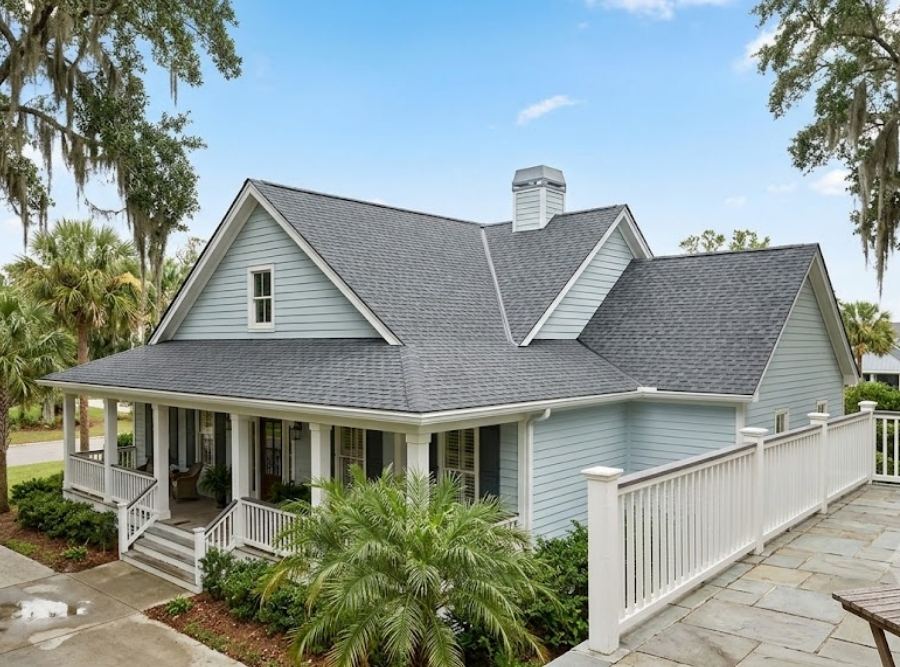
Southern-style house with light blue siding, complex dark roof, and covered porch in a mature garden.

Does a New Roof Lower My Homeowners Insurance in Beaufort, SC?

Quick Answer:
A new roof may lower your homeowners insurance in Beaufort, SC, but it is not guaranteed. Insurance companies often consider roof age, condition, wind resistance, and installation quality when determining risk, but your premium also depends on factors such as your home’s location, claims history, coverage limits, deductible, and the insurer’s underwriting guidelines.

An insurance renewal letter arrives, and suddenly the age of your roof becomes the most important part of your home. For many Beaufort homeowners, that is the first indication that insurance companies evaluate far more than whether a roof is currently leaking. Questions about roof age, replacement dates, construction methods, and storm resistance have become increasingly common, especially for homes exposed to the coastal weather conditions that define life in the South Carolina Lowcountry.

It is easy to assume that replacing an older roof will automatically reduce your homeowners insurance premium. After all, a new roof should represent less risk than one that has weathered twenty years of tropical storms, humidity, and intense summer heat. While there is truth to that thinking, the reality is considerably more nuanced. A roof replacement can improve your insurance position in several important ways, but lower premiums are only one possible outcome. In many cases, the greatest benefit is maintaining eligibility for coverage, expanding your insurance options, or preventing underwriting concerns before they become larger and more expensive problems.

For homeowners in Beaufort, Port Royal, Lady’s Island, Mossy Oaks, Habersham, Battery Creek, and other coastal communities, understanding this distinction is important before making a significant investment in a roof replacement. The decision should be based on the roof’s actual condition and your long-term goals for protecting your home, not simply the expectation that insurance savings will offset the cost.

Why Insurance Companies Care So Much About Roof Age

Insurance companies are ultimately evaluating risk. Every homeowners policy represents the possibility that the insurer will one day need to pay for storm damage, water intrusion, or structural repairs. Because the roof serves as the home’s primary defense against wind and rain, its condition has a direct influence on that calculation.

In Beaufort, this evaluation carries even more weight because of the area’s coastal environment. Homes here routinely experience conditions that are harder on roofing systems than many inland communities ever see. Hurricane season brings the possibility of sustained high winds and flying debris, while heavy summer thunderstorms test flashing, valleys, and roof penetrations with wind-driven rain. Salt-laden air accelerates corrosion of exposed metal components, prolonged humidity affects ventilation and moisture management, and years of ultraviolet exposure slowly reduce the flexibility and weather resistance of many roofing materials. Even a roof that appears perfectly acceptable from the street may have hidden weaknesses that become evident only during a severe weather event.

As roofing materials age, insurers generally view the likelihood of future claims as increasing. Architectural shingles gradually lose protective granules, sealant strips weaken, flashing may begin separating from adjoining materials, and repeated thermal expansion can affect exposed fasteners and transition points. These changes do not necessarily mean the roof has failed, but they do increase the probability that the next major storm could create damage requiring an insurance claim.

This explains why homeowners are increasingly receiving requests for roof photographs, installation dates, inspection reports, or documentation proving when a replacement was completed. The insurance company is not simply looking for obvious leaks. Instead, underwriters are trying to determine how likely the roof is to withstand future weather events without generating a costly loss.

Roof Age Is Only One Piece of the Underwriting Process

One of the biggest misconceptions we encounter is the belief that insurance companies make decisions based solely on how old the roof is. Age certainly matters, but it is only one part of a much larger evaluation.

A roof that is fifteen years old but professionally installed, properly ventilated, well maintained, and fully documented may present less concern than a roof that is only eight years old but has already undergone multiple repairs or shows evidence of poor workmanship. Insurance companies understand that installation quality, maintenance history, and overall construction often influence long-term performance just as much as the date the shingles were installed.

Documentation also plays a larger role than many homeowners realize. We have seen situations where homeowners believed their relatively new roof would automatically improve their insurance situation, only to discover that the carrier still considered the roof to be much older because replacement records had never been submitted. From the insurer’s perspective, an undocumented replacement may as well not exist until appropriate proof is provided.

This issue becomes particularly relevant during home sales. Buyers frequently discover that their preferred insurance carrier wants confirmation of the roof’s age before issuing a policy. If the seller cannot produce invoices, permit information, or other documentation, the transaction can become more complicated than anyone anticipated.

Why a New Roof Doesn’t Automatically Lower Your Insurance Premium

The simple answer is that replacing your roof changes one part of the insurance company’s risk assessment, but it does not change every factor used to calculate your premium.

Insurance companies consider numerous variables when pricing homeowners coverage. The replacement value of the home, local catastrophe exposure, prior claims, deductible selection, policy limits, neighborhood characteristics, construction type, and broader market conditions all influence what you ultimately pay. Even if your roof replacement qualifies for a discount or improves your underwriting profile, other changes within the policy can offset those savings.

This is why two Beaufort homeowners can replace their roofs in the same year using similar materials and receive completely different insurance outcomes. One homeowner may qualify for meaningful credits because of the carrier’s underwriting guidelines and the specific features incorporated into the roofing system. Another may receive only a modest adjustment because the insurer places greater emphasis on other aspects of the property’s overall risk profile.

The important takeaway is that a roof replacement should never be viewed as a guaranteed method of reducing insurance costs. Instead, it should be considered one element of improving the home’s overall insurability while reducing the likelihood of future storm-related losses.

Understanding Wind Mitigation and Why It Matters

Many homeowners use the terms “new roof” and “wind mitigation” interchangeably, but they describe two different concepts.

A roof can be brand new without incorporating the construction features that some insurers recognize for wind-mitigation credits. Likewise, a roofing system designed specifically to improve resistance against hurricane-force winds involves much more than simply installing fresh shingles. The performance of the entire assembly matters, including how the roof deck is attached, the type of underlayment installed, the fastening pattern, roof-to-wall connections, edge protection, flashing integration, and the methods used to reduce water intrusion if the primary roof covering is damaged during a storm.

South Carolina recognizes qualifying mitigation measures that strengthen homes against hurricane damage, and some insurance carriers offer premium credits for properties that meet their underwriting requirements. However, there is no universal discount, and not every insurer evaluates mitigation improvements the same way. One carrier may place significant value on certain construction features, while another may weigh them differently or require additional documentation before applying any credits.

This is why we encourage homeowners to speak with their insurance agent before replacing the roof if insurance savings are one of their primary goals. Understanding exactly what the insurer recognizes—and what documentation will be required afterward—helps avoid disappointment and ensures that important opportunities are not overlooked during construction.

Another point that is often misunderstood involves FORTIFIED Roof construction. Many homeowners have heard the term and assume it simply means installing stronger shingles. In reality, a FORTIFIED Roof is a verified performance standard that includes specific construction practices intended to reduce storm damage. Whether pursuing that designation makes sense depends on the home, the budget, the insurer, and the owner’s long-term goals. It should never be assumed that every roof replacement automatically meets those requirements.

A New Roof Often Improves Insurability More Than It Lowers Premiums

Focusing only on whether a premium decreases can cause homeowners to overlook one of the biggest advantages of replacing an aging roof: maintaining strong insurance options.

Insurance companies today are paying closer attention to roof condition than they did a decade ago. Across coastal South Carolina, homeowners are increasingly encountering underwriting inspections, requests for updated roof information, and questions about prior repairs before policies are renewed. In some situations, an aging roof does not simply result in higher premiums. It can reduce the number of companies willing to insure the property or require replacement before new coverage is issued.

That difference becomes especially important when buying or selling a home. A buyer may qualify for financing, complete inspections, and be ready to close, only to discover that the insurer wants additional documentation or considers the roof beyond its preferred underwriting guidelines. Replacing the roof before reaching that point often gives homeowners more flexibility and allows them to make decisions on their own schedule rather than under pressure from an insurance deadline or pending real estate transaction.

Planning a replacement also provides opportunities that emergency situations rarely allow. The roof deck can be thoroughly evaluated, ventilation deficiencies can be corrected, flashing details can be improved, and installation methods can be selected with long-term coastal performance in mind rather than simply restoring the previous roof as quickly as possible. In many cases, that thoughtful approach provides value long after the initial project has been completed.

Does a Metal Roof Lower Insurance More Than Architectural Shingles?

Homeowners throughout Beaufort often ask whether choosing a metal roof instead of architectural shingles will result in larger insurance savings. While metal roofing has an excellent reputation for durability and can perform exceptionally well in coastal environments, there is no universal rule stating that every insurance company offers a greater discount simply because the roof is metal. Insurance carriers evaluate overall risk, and that evaluation typically considers the entire roofing system rather than a single material.

A properly installed architectural shingle roof built to current building standards may receive the same consideration from an insurer as a metal roof if both systems provide comparable wind resistance and meet the carrier’s underwriting requirements. Conversely, a poorly installed metal roof with inadequate flashing, improper fastening, or corrosion-prone components may present more concern than a high-quality shingle roof that was installed correctly. The roofing material certainly matters, but installation quality, documentation, and how the system performs as a whole are often just as important.

That distinction becomes especially meaningful in Beaufort’s coastal climate. Homes near the Beaufort River, Port Royal Sound, Lady’s Island, Fripp Island, St. Helena Island, and other waterfront communities are exposed to salt air, frequent humidity, and strong coastal winds throughout the year. These conditions can accelerate corrosion on exposed metal components if the correct materials are not used. Whether the roof is metal, architectural shingle, slate, or synthetic, success depends on using products appropriate for the coastal environment and installing every component according to manufacturer specifications and current building requirements.

For that reason, homeowners should choose a roofing material because it best fits their home’s architecture, expected lifespan, maintenance preferences, storm exposure, and long-term goals rather than because someone suggested it would automatically produce a larger insurance discount. The insurance benefit should be viewed as one factor among many instead of the primary reason for selecting a particular roofing system.

Why Your Insurance Premium Can Still Increase After Installing a New Roof

Perhaps the most frustrating situation for homeowners is replacing an aging roof, notifying their insurance company, and then discovering that their annual premium has still increased. At first glance, this seems contradictory. If the home is now less risky, shouldn’t the insurance cost decrease?

The answer is that homeowners insurance premiums reflect far more than the condition of the roof alone. Insurance companies continually adjust rates based on the cost of rebuilding homes, inflation affecting labor and materials, regional storm activity, changes in catastrophe models, local claims experience, policy coverage limits, deductibles, and many other underwriting considerations. Even if your new roof qualifies for a credit, those broader market factors may offset the savings, resulting in an overall premium that is similar to—or even higher than—the previous year’s renewal.

This is why comparing only the final premium can sometimes be misleading. A homeowner may actually receive a roof-related credit while simultaneously experiencing increases elsewhere within the policy. Without reviewing the policy details with an insurance agent, it can be difficult to determine exactly how much impact the roof replacement had on the final price. In many cases, the premium might have increased even more had the older roof remained in place.

It is equally important to remember that homeowners insurance and flood insurance are separate forms of protection. A new roof can reduce the likelihood of wind-driven rain entering the home during a storm, but it does not change a property’s flood zone, elevation, or exposure to rising water. Throughout Beaufort County, particularly near marshes, tidal creeks, and low-lying waterfront areas, homeowners often need to evaluate both forms of coverage independently.

Another misconception involves manufacturer warranties. Registering a roofing warranty is an important step that protects the homeowner under the manufacturer’s terms, but it does not directly affect insurance pricing. Insurance underwriting, manufacturer warranties, and contractor workmanship responsibilities are separate systems that serve different purposes.

Documentation Matters Almost as Much as the Roof Itself

One of the most overlooked aspects of a roof replacement is the documentation that accompanies the finished project. Insurance companies, future buyers, home inspectors, lenders, and even future contractors may eventually ask when the roof was installed, what materials were used, whether permits were obtained, and whether the installation complied with current building requirements. Those questions become much easier to answer when detailed records already exist.

Unfortunately, many homeowners receive little more than a basic invoice after their roof replacement is complete. Years later, when an insurance company requests proof of the installation date or a buyer asks for documentation during a home sale, important information may be missing. That uncertainty can create unnecessary delays and additional inspections that could have been avoided with better recordkeeping from the beginning.

At Apex Roofing of the Lowcountry, we believe documenting a project is part of doing the job correctly. Before preparing an estimate, Ralph or Pierce personally gets on the roof to evaluate the system firsthand rather than relying solely on measurements taken from the ground. Every homeowner receives an itemized written estimate before any materials are ordered, ensuring there is complete clarity about what work is recommended and why.

Once the project begins, we obtain the required permits, photograph the roof throughout the installation process, and carefully document conditions discovered after the existing roofing material has been removed. This often includes hidden decking deterioration, flashing deficiencies, ventilation concerns, or previous repairs that could not have been identified from the exterior alone. Those photographs not only help explain the work being completed but also create a valuable record for the homeowner long after the project has finished.

Our process continues after installation is complete. We perform a magnetic sweep to remove roofing nails and metal debris, register the applicable manufacturer warranty, and complete a final walkthrough with the homeowner before considering the project finished. While none of these steps guarantee an insurance discount, they do provide homeowners with organized documentation that can be valuable during future insurance reviews, warranty claims, maintenance planning, or real estate transactions.

As a CertainTeed ShingleMaster-certified, owner-operated roofing contractor, Apex Roofing of the Lowcountry also maintains South Carolina License #57706 and Town of Bluffton License #0620033323. Those credentials reflect our commitment to professional workmanship, but just as importantly, they reinforce our belief that homeowners deserve transparency throughout every stage of the roofing process.

Questions to Ask Before Replacing Your Roof for Insurance Reasons

If insurance concerns are one of the primary reasons you are considering a roof replacement, it is worth slowing down long enough to gather accurate information before making a decision. Too many homeowners assume they understand how their policy works only to discover after construction that their expectations were based on incomplete information.

The first conversation should always be with your insurance agent. Ask whether the roof’s age is affecting your policy, whether replacement is required for renewal, whether specific wind-mitigation features qualify for credits, and exactly what documentation the insurance company will require after the work is complete. These answers provide a much stronger foundation for decision-making than relying on generalized information found online.

The second step is having the roof evaluated by a qualified local roofing contractor who will actually inspect the roof rather than estimating its condition from the ground. A professional inspection can determine whether the roof truly needs replacement, identify hidden issues that may influence both construction and insurance considerations, and explain which installation methods are most appropriate for Beaufort’s coastal environment.

Most importantly, avoid making the decision based solely on the expectation of immediate insurance savings. A roof replacement should first solve a roofing problem, protect the home from future weather events, and provide long-term reliability. Any insurance benefits should be viewed as an additional advantage rather than the sole justification for the investment.

A New Roof Can Strengthen More Than Your Insurance Position

A new roof may lower homeowners insurance in Beaufort, but the greater value often lies in strengthening the home’s overall insurability, improving long-term storm protection, and reducing the uncertainty that accompanies an aging roofing system. A professionally installed roof supported by proper permits, thorough documentation, and modern construction practices places homeowners in a much stronger position whether they are preparing for hurricane season, renewing insurance coverage, selling the property, or simply protecting one of their largest investments.

Every home is different, and so is every insurance policy. The most reliable approach is to understand both sides of the equation. Speak with your insurance company to learn exactly how your carrier evaluates roofing systems, then have your roof inspected by a local contractor who understands Beaufort’s coastal climate and can explain its actual condition without guesswork. That combination allows you to make an informed decision based on facts rather than assumptions.