
What’s the Difference Between Roof Repair and Needing Full Replacement After a Storm?
Quick Answer:
Repair is usually the right call when a roof is under roughly 15 years old, storm damage is confined to one or two roof slopes, and the surrounding shingles are still flexible and well-sealed. Full replacement becomes the smarter long-term investment once a roof is 15 to 20+ years old, damage is spread across multiple slopes, or the shingles have grown too brittle to remove without cracking. Apex Roofing gets on every roof before recommending either option, assessing storm damage for homeowners throughout Hilton Head Island, Sea Pines, Palmetto Dunes, and the surrounding Lowcountry.
A powerful thunderstorm, tropical system, or hurricane can leave homeowners staring at their roof with one question that seems impossible to answer from the ground: Can this be repaired, or do I need a whole new roof? The uncertainty only grows when different people offer different opinions. Your insurance adjuster may say the damage appears repairable. A neighbor insists everyone on the street is getting new roofs. Another contractor immediately recommends replacement. Before long, it feels like everyone has an opinion, yet none of the answers seem to explain why.
We hear this question frequently from homeowners throughout Hilton Head Island, whether they live in Sea Pines, Palmetto Dunes, Hilton Head Plantation, Indigo Run, Wexford, Forest Beach, or one of the island’s many waterfront communities. Coastal storms affect every roof differently, even within the same neighborhood. Two homes built side by side with similar roofing materials may experience very different outcomes because of wind direction, previous repairs, roof design, surrounding trees, or simply how the storm moved across the property.
The truth is that there is no universal rule that says a certain number of missing shingles automatically requires a replacement or that every leak can be solved with a simple repair. Every storm-damaged roof tells its own story. The goal of a professional inspection is to understand that story, determine what actually failed, and recommend the solution that protects the home for the long term rather than simply addressing the most obvious symptom.
The Storm Doesn’t Make the Decision—The Roof’s Overall Condition Does
One of the biggest misconceptions after severe weather is that the storm itself determines whether a roof should be replaced. Homeowners often assume that if the winds reached hurricane strength, a replacement must be necessary. Others believe that if only a handful of shingles are missing, a repair is always enough. In reality, neither conclusion is based on how roofing systems actually perform.
A storm reveals the condition of a roof far more often than it creates it. Two roofs may experience the same wind speeds, yet one requires only a localized repair while the other has reached the point where replacement becomes the more practical option. The difference usually comes down to the condition of the roofing system before the storm ever arrived. A relatively new roof with properly bonded shingles, sound flashing, and secure fasteners often withstands coastal weather remarkably well. An older roof that has already endured years of intense ultraviolet exposure, humidity, salt air, and previous storms may respond very differently to the same event.
That’s why we never make recommendations based solely on the weather report or the number of shingles visible in the yard. We evaluate how the entire roofing system performed during the storm. Did the wind simply remove a few isolated shingles, or did it begin breaking adhesive seal strips across multiple roof slopes? Are the flashing details still directing water properly, or have they started separating at critical transitions? Has the storm exposed an otherwise healthy roof, or has it accelerated the decline of a roofing system that was already nearing the end of its service life?
Answering those questions requires looking beyond the obvious damage. The goal isn’t to decide whether the storm was severe. The goal is to determine whether the roof can continue protecting the home with confidence after appropriate repairs or whether the damage has changed the long-term outlook of the entire system.
A Few Missing Shingles Don’t Tell the Whole Story
It’s completely understandable why homeowners focus on the shingles they can see. After a storm, the most visible evidence is often a few pieces of roofing material scattered across the lawn or resting in the gutters. Those missing shingles naturally become the center of attention, but they rarely tell the complete story.
Wind doesn’t always remove shingles completely. In many cases, the more significant damage occurs when strong gusts lift the shingles just enough to break the adhesive seal that normally holds them in place. Once those seals are compromised, the shingles may settle back into their original position, making the roof appear almost untouched from the ground. However, their ability to resist future wind events may have been significantly reduced.
This is one reason homeowners are often surprised when a roof that “looks fine” begins leaking weeks later. The visible damage wasn’t the primary problem. The storm may have loosened flashing around a chimney, shifted ridge caps, stressed roof penetrations, or allowed water to begin entering beneath the shingles during wind-driven rain. None of those conditions are easy to recognize without getting onto the roof, yet they frequently determine whether a repair is straightforward or whether the damage is more extensive than it first appeared.
We’ve also inspected roofs where homeowners were convinced they needed a complete replacement because several shingles had blown off during a storm. After a thorough inspection, the remainder of the roofing system was found to be in excellent condition, allowing targeted repairs to restore full performance. We’ve seen the opposite as well. A roof with very little visible damage from the driveway revealed widespread wind uplift across multiple slopes once inspected up close. Appearances alone can be misleading, which is why storm damage should never be judged solely from the ground.
Sometimes the Roof Was Already Telling a Story Before the Storm Arrived
Storms often receive all the blame because they are the event homeowners remember most clearly. The rain begins, the wind intensifies, and shortly afterward a leak appears inside the home. It’s natural to assume the storm caused every bit of the damage. In many situations it certainly contributes, but storms frequently expose weaknesses that have been developing quietly for years.
Throughout Hilton Head Island, roofing systems spend every season facing conditions that gradually change how they perform. Intense summer sunlight slowly dries roofing materials. High humidity encourages moisture to linger in shaded areas. Salt carried inland from the Atlantic accelerates corrosion on flashing and exposed metal components. Repeated cycles of heat, cooling, and coastal storms gradually weaken adhesive seal strips that once held shingles tightly in place. None of those changes happen overnight, and most homeowners never notice them because they occur a little at a time.
Then a tropical storm arrives. Wind begins lifting shingles that have already lost much of their original flexibility. Rain finds tiny openings around aging flashing that had remained watertight during lighter storms. Areas that had been close to failure suddenly cross that threshold. The storm may appear to be the cause, but in reality it has simply exposed roofing components that were already approaching the end of their reliable service life.
This distinction matters because it influences whether a repair makes practical sense. If the surrounding roofing materials remain healthy and have years of expected service life ahead, repairing the storm damage may restore the roof to excellent condition. If the damage occurs on a roof that has widespread age-related deterioration across multiple areas, replacing isolated sections may simply postpone larger problems that are already developing elsewhere.
Repair Is Often the Right Choice—When the Roof Is Still a Good Roof
Many homeowners assume roofing contractors prefer replacing roofs because it represents a larger project. In reality, recommending replacement when a quality repair would solve the problem doesn’t serve the homeowner, and it doesn’t build the long-term relationships that reputable contractors value. A well-executed repair on an otherwise healthy roof can often provide years of reliable performance.
The key question isn’t whether repairs are possible. Nearly every roof can be repaired in some way. The more important question is whether those repairs leave the homeowner with a roofing system they can trust through future hurricane seasons, heavy summer thunderstorms, and years of coastal exposure. If replacing damaged shingles, correcting flashing details, and restoring the affected areas returns the roof to dependable condition, a repair is often the smartest and most economical solution.
Where homeowners sometimes run into difficulty is assuming that every repair produces the same long-term result regardless of the roof’s age. Roofing materials change over time. Older shingles become less flexible, colors fade from years of sun exposure, and some products become increasingly difficult to match or repair without causing additional damage during the process. On certain aging roofs, even careful repairs can create new challenges simply because the surrounding materials have reached the end of their practical repairability.
That’s why every recommendation should begin with the same question: If this were our own home, would we feel confident relying on this repaired roof for years to come? If the honest answer is yes, repair often makes excellent sense. If the answer is no, replacement may ultimately prove to be the better investment—not because the storm demanded it, but because the condition of the roof does.
When a Full Replacement Becomes the Better Long-Term Decision
There are situations where repairing storm damage simply isn’t the most responsible recommendation. That doesn’t mean the roof has to be falling apart or that half the shingles are missing. In many cases, the deciding factor is whether the roof can realistically continue protecting the home through future storms after the repairs are completed.
One of the most important considerations is the roof’s remaining service life. If a roof has already spent fifteen, twenty, or more years exposed to Hilton Head Island’s intense sun, salt-laden air, heavy rainfall, and repeated tropical systems, the storm may have affected far more than the visibly damaged area. Shingles that have become brittle over time often crack when individual pieces are lifted for repair. Adhesive seal strips that once provided excellent wind resistance may have weakened across multiple roof slopes, even where shingles remain in place. Flashing may have reached the point where replacing one section leaves other aging transitions vulnerable to the next major storm.
A full replacement may also become the better option when storm damage is widespread rather than isolated. Damage scattered across multiple roof sections often requires so many individual repairs that the roof becomes a patchwork of old and new materials without significantly improving its long-term reliability. At that point, homeowners may spend substantial money on repairs while still facing another major roofing project in the near future. Replacing the roof all at once often provides greater value because it restores the roofing system as a complete, integrated assembly instead of addressing one problem area at a time.
Another factor that cannot be overlooked is future weather. Along the South Carolina coast, roofs rarely have the luxury of years without severe weather. If the next tropical storm arrives a few months after repairs are completed, homeowners deserve confidence that the roof protecting their family has been restored to a condition capable of handling what comes next. Sometimes that confidence comes from a well-executed repair. Other times, it comes from knowing the entire roofing system has been renewed.
Why Insurance Adjusters and Roofing Contractors Sometimes Reach Different Conclusions
One of the most confusing parts of a storm claim occurs when the insurance adjuster recommends repairs while a roofing contractor recommends replacement. Homeowners often feel caught in the middle, wondering whether someone is wrong or whether one side is simply trying to save or spend more money.
In reality, these professionals often approach the same roof from different perspectives. An insurance adjuster is responsible for documenting storm-related damage and determining how the policy applies to that damage. A roofing contractor is evaluating whether the roof can continue performing reliably after repairs are completed. Those are related questions, but they are not identical.
For example, a contractor may discover that the damaged shingles are no longer practically repairable because of their age and condition. Removing and replacing isolated sections could cause additional breakage, leave inconsistent sealing, or create a roof with varying levels of weather resistance. The contractor’s concern is the long-term performance of the roofing system. The adjuster is evaluating the covered damage under the policy. Sometimes those viewpoints align immediately. Other times, additional documentation, photographs, or conversations are needed to fully explain the roof’s condition.
This is one reason we believe homeowners deserve clear explanations rather than blanket statements. If we recommend repairs, we’ll explain why we believe the roof remains a strong candidate for continued service. If we recommend replacement, we’ll walk you through the specific conditions that led us to that conclusion. Our role isn’t to argue with anyone involved in the claim. It’s to provide an honest assessment based on what we observe on the roof itself.
The Damage You Can’t See Is Often the Damage That Matters Most
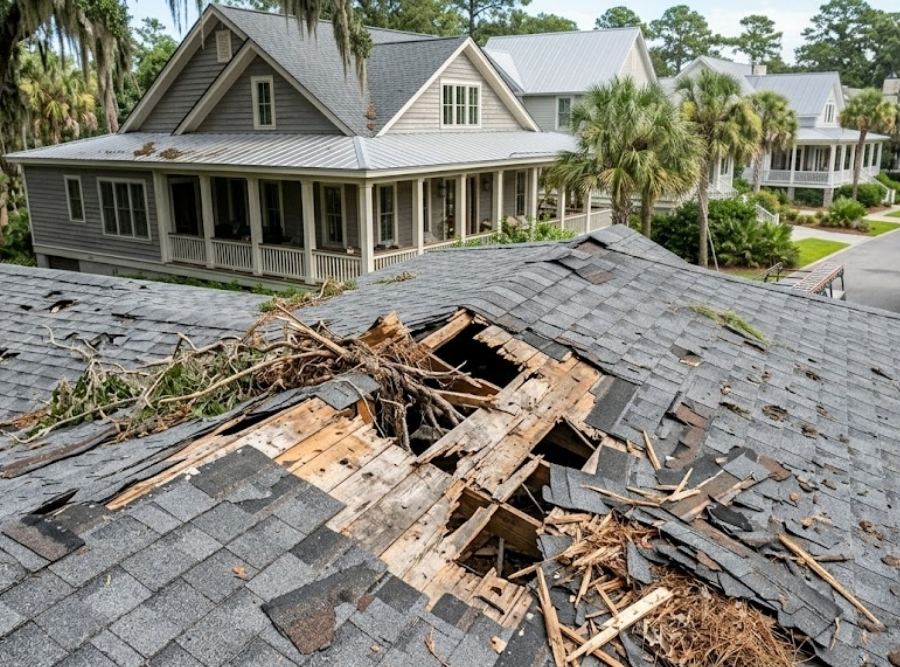
After a storm, it’s natural to look for obvious warning signs. Missing shingles, bent flashing, or tree limbs resting on the roof immediately capture attention. Yet some of the most significant storm damage isn’t visible from the driveway and may not even produce an immediate leak inside the home.
When wind lifts shingles, it can weaken the adhesive bonds that help the roof resist future uplift. Flashing around chimneys, skylights, plumbing vents, and roof-to-wall intersections may separate just enough to allow wind-driven rain to bypass the protective layers beneath the shingles. Underlayment can become exposed to sunlight and moisture where roofing materials have shifted, gradually reducing its effectiveness long before homeowners notice interior staining.
Water also has a remarkable ability to travel before it becomes visible. A stain appearing in a bedroom ceiling may have originated many feet away near a valley, chimney, or roof penetration. Moisture can move along roof decking, framing members, and insulation before finally appearing inside the living space. By the time homeowners notice the first visible sign, water may have already affected a much larger area than expected.
This is why storm inspections should never focus only on what is easiest to see. A thorough evaluation looks for the subtle clues that reveal how the roofing system responded to the storm as a whole. Understanding those details helps determine whether the roof remains dependable or whether hidden damage has changed its long-term outlook.
Waiting Too Long Can Change the Entire Conversation
Many homeowners hope a small roofing issue will simply wait until life becomes less busy. After a storm, it’s common to think, “We’ll watch it for a while,” especially if no active leak appears right away. Unfortunately, roofing systems rarely remain unchanged after they’ve been compromised.
A lifted shingle may continue allowing wind to work beneath surrounding shingles during every storm that follows. A small flashing separation can admit repeated moisture into the roof assembly, gradually affecting the decking beneath. Underlayment that became exposed during the original storm continues aging under direct sunlight, reducing the additional protection it was designed to provide. What began as a relatively localized repair can gradually become a larger restoration involving roof decking, insulation, drywall, fascia, or interior finishes.
Delays can also complicate insurance claims. While every policy is different, documenting storm damage promptly and addressing necessary repairs in a timely manner generally creates a much clearer record of what occurred. Waiting through multiple storms before scheduling an inspection can make it more difficult to distinguish original storm damage from deterioration that developed afterward.
For homeowners on Hilton Head Island, timing is especially important because storm season is rarely an isolated event. One named storm may be followed by another only weeks later. Protecting the roof before the next round of severe weather often prevents relatively minor damage from becoming significantly more expensive.
How Apex Roofing Helps Homeowners Make the Right Decision
One of the most valuable things a roofing contractor can provide after a storm isn’t a sales pitch—it’s clarity. Homeowners deserve to understand what actually happened to their roof, why it happened, and which solution makes the most sense based on the condition of the entire roofing system rather than a single damaged area.
At Apex Roofing, Ralph or Pierce personally get on the roof before preparing an estimate because meaningful storm assessments cannot be completed from the driveway. We document our findings with photographs, evaluate not only the obvious damage but also the surrounding roofing components, and explain our recommendations in straightforward language. If repairs are appropriate, we’ll tell you why we believe the roof can continue serving your home reliably. If replacement is the better long-term investment, we’ll show you the conditions that led us to that conclusion rather than asking you to simply take our word for it.
If roofing work is needed, our process reflects the same commitment to doing the job correctly from beginning to end. We provide itemized written estimates before any work is discussed, coordinate required permits through the appropriate local jurisdiction, document the project throughout construction, perform a magnetic sweep after tear-off to collect stray fasteners, register applicable manufacturer warranties upon completion, and conduct a final walkthrough with the homeowner before considering the project finished. Those steps don’t eliminate storm damage, but they do help ensure homeowners understand exactly what is being done and why.
The Right Storm Decision Is the One You’ll Still Feel Confident About Years From Now
After a major storm, it’s understandable to focus on immediate concerns. You want to stop the leak, protect your home, work through the insurance process, and return life to normal as quickly as possible. Those priorities matter, but the decision between repairing and replacing a roof shouldn’t be based only on today’s problem. It should also consider how the roof is likely to perform through the next hurricane season, the next series of summer thunderstorms, and the years that follow.
A quality repair can absolutely be the right answer when the roof remains structurally sound and has meaningful service life ahead of it. A full replacement becomes the wiser investment when widespread storm damage, aging materials, or declining repairability make continued patching a short-term solution rather than a lasting one. The goal isn’t to recommend the biggest project or the least expensive one. It’s to recommend the option that genuinely protects your home and gives you confidence every time severe weather appears in the forecast.
Frequently Asked Questions About Storm Roof Repair vs. Replacement
How do I know if hurricane damage requires a full roof replacement?
Hurricane damage typically points toward replacement when a roof is already 15 to 20+ years old, when wind uplift or shingle loss is spread across multiple roof slopes rather than one isolated area, or when the shingles have become too brittle to remove and replace without cracking the surrounding material. A licensed roofing contractor should physically inspect the roof rather than assess it from the ground, since hidden damage often influences the recommendation more than what’s visible from the yard.
Will insurance cover a storm roof replacement in Beaufort County, South Carolina?
Most homeowners insurance policies in Beaufort County cover storm-related roof damage caused by wind, hail, or a named storm, though coverage depends on the specific policy, the roof’s age, and whether the damage is classified as sudden storm damage versus gradual wear. Coastal windstorm and named-storm deductibles in South Carolina are often separate from the standard deductible and can be a percentage of the home’s insured value rather than a flat dollar amount. Homeowners should review their policy’s wind/hail and named-storm provisions and document damage promptly to support a claim.
How quickly should I schedule a roof inspection after a storm?
Homeowners should schedule a professional roof inspection within days of a storm, even without a visible leak, because wind can break shingle seal strips and shift flashing without producing an immediate interior leak. Prompt inspection creates a clear damage record for insurance purposes and prevents small issues like a lifted shingle or separated flashing from worsening during the next storm. Along the South Carolina coast, storm season often brings multiple named systems in close succession, so early inspection reduces the risk of compounding damage.
What’s the difference between wind damage and impact damage for an insurance claim?
Wind damage refers to shingles lifted, torn, or blown off by high winds, along with compromised seal strips that reduce a roof’s resistance to future storms. Impact damage refers to physical damage from debris, hail, or falling limbs striking the roof surface, which often leaves visible bruising, cracking, or punctures. Insurance adjusters may evaluate and document these two damage types differently, which is one reason a roofing contractor’s assessment and an adjuster’s assessment can sometimes reach different conclusions about the same roof.
Not Sure Which Option Is Right for Your Roof?
If a recent storm has you weighing repair against replacement, Apex Roofing of the Lowcountry serves homeowners throughout Hilton Head Island, Bluffton, and the surrounding Lowcountry. Learn more about our emergency roof repair services, or explore our roof replacement process if a full replacement turns out to be the better long-term investment for your home.

Ralph Brehany is the owner and president of Apex Roofing of the Lowcountry, a licensed residential roofing contractor he founded alongside his son, Pierce, serving Bluffton, Hilton Head Island, Beaufort, and the surrounding Lowcountry. The company is CertainTeed ShingleMaster certified and holds SC License #57706, handling roof repair, replacement, and new installation across Beaufort and Jasper County. Ralph is known for staying hands-on throughout every project, from the initial estimate to daily progress updates on site.