
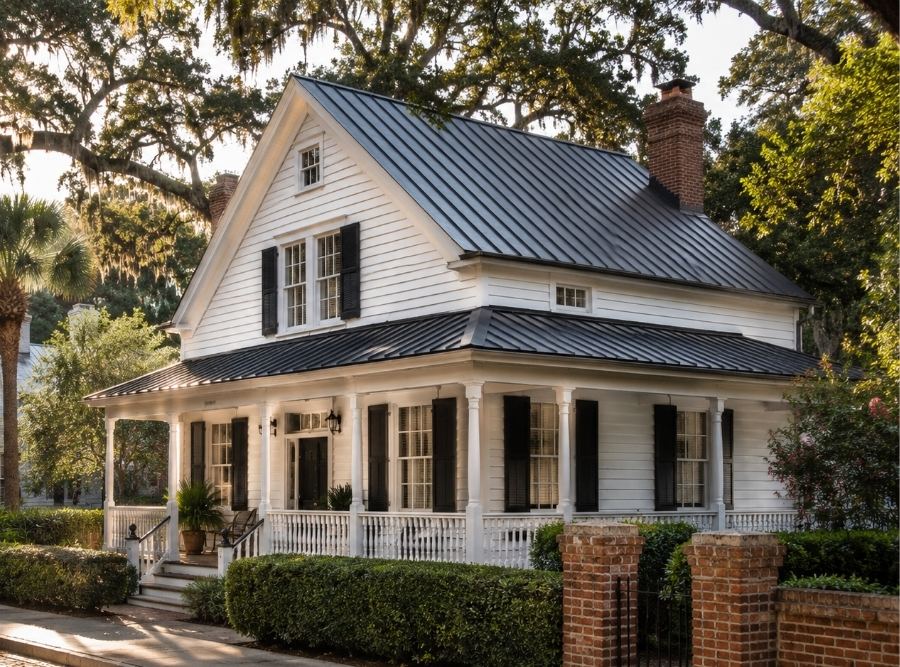
What Roofing Materials Are Allowed in Old Town Bluffton Historic District?
Quick Answer:
There’s no single approved-materials checklist for Old Town Bluffton’s Historic District, instead, the Town’s Historic Preservation Commission (HPC) reviews each roof against how well it complements the home’s architecture and the surrounding historic streetscape. Architectural asphalt shingles, standing seam metal, cedar, and other historically compatible products are commonly used, but a change in material, color, or profile typically requires a Certificate of Appropriateness approved by the HPC, while simple in-kind repairs may qualify for a faster staff-level review. Apex Roofing works with homeowners throughout the district to select compatible materials and navigate Town review before work begins.
Old Town Bluffton has a character unlike anywhere else in the South Carolina Lowcountry. Strolling along Calhoun Street, passing the Heyward House, or admiring the cottages and churches overlooking the May River, it becomes clear that the community values preserving its architectural heritage. That preservation extends beyond front porches and historic facades. The roof above a home plays a significant role in defining its appearance, which is why replacing a roof in the Historic District involves more than choosing a product that fits the budget or offers the longest warranty.
Homeowners often begin the process with a straightforward question: “What roofing materials am I allowed to use?” The answer is more nuanced than many expect because historic review focuses on preserving the overall architectural character of the district rather than approving or rejecting individual products in isolation. The material itself certainly matters, but so do its profile, texture, color, visibility, and how naturally it fits the home’s design. Understanding those considerations before ordering materials can save weeks of delays, unnecessary expense, and the frustration of revising a project after it is already underway.
How Does Bluffton’s Historic Review Process Actually Work?
Roofing projects in Old Town Bluffton are reviewed under the Town’s Unified Development Ordinance (UDO) historic district design standards, and the review path depends on the scope of work. Minor, in-kind repairs that don’t change a roof’s material, color, or profile may qualify for a Site Feature Permit, which the Historic Preservation Review Committee (HPRC) — a staff-level committee can review administratively without a full public hearing.
A change in roofing material, color, or profile typically requires a Certificate of Appropriateness – Historic District (COFA-HD). That process includes an application check-in meeting, review by Town staff and the HPRC, and a public hearing before the Historic Preservation Commission (HPC), the board that functions as Bluffton’s board of architectural review under South Carolina state law. The HPC meets on the first Wednesday of every month at 6 p.m. at Town Hall, 20 Bridge Street, and may approve, approve with conditions, or deny an application based on the UDO’s design criteria.
Old Town Bluffton has held National Register Historic District status since 1996 and includes more than 80 contributing historic structures across roughly 94.6 acres along the May River. Because both the review track and the timeline depend on the specific scope of a project, homeowners should confirm requirements with the Town’s Historic Preservationist before ordering roofing materials or signing a contract.
Historic Compatibility Is About More Than Simply Choosing an “Approved” Roof
One of the biggest misconceptions surrounding roof replacement in Old Town Bluffton is the belief that there is a universal list of roofing materials that are either approved or prohibited. Many homeowners hope for a simple checklist that says yes to one product and no to another. Historic preservation rarely works that way because every home contributes differently to the character of the district, and every roof presents its own architectural considerations.
The purpose of historic design standards is not to freeze homes in time or prevent thoughtful improvements. Instead, they encourage repairs and replacements that preserve the visual qualities that make Old Town Bluffton distinctive. Roof shape, pitch, edge details, and the way roofing materials appear from public streets often matter just as much as the product itself. A material that complements one historic home may not necessarily be the best choice for another property with a different architectural style or period of construction.
Many homeowners are pleasantly surprised to learn that modern roofing technology and historic preservation are not automatically at odds. Advances in roofing materials have made it possible to improve weather resistance, wind performance, and longevity while still maintaining a traditional appearance. The goal is not to reject innovation but to balance modern performance with architectural compatibility so the finished roof protects the home without diminishing the historic streetscape that residents value.
Why Standing Seam Metal Creates So Many Questions
Few roofing materials generate as many questions in Old Town Bluffton as standing seam metal roofing. Some homeowners assume every metal roof is historically appropriate because metal has been used on Southern buildings for generations. Others have heard the opposite and believe that no metal roof would ever receive approval in a historic district. Neither assumption tells the whole story.
The term “metal roof” describes a wide range of products that can look dramatically different from one another. A concealed-fastener standing seam system presents a refined architectural appearance with clean vertical lines, while an exposed-fastener agricultural panel creates a much more utilitarian look. Although both are manufactured from metal, they contribute very different visual character to a home. Historic review often considers those distinctions because the roof should complement the architecture rather than draw attention away from it.
Color and finish also influence how a metal roof fits within the surrounding neighborhood. A subtle matte finish that blends naturally with neighboring historic structures creates an entirely different impression than a bright reflective panel designed for commercial or agricultural buildings. These details explain why homeowners should avoid assuming that every standing seam roof or every metal roof in general will be viewed the same way. Selecting the right system begins with understanding the home’s architecture instead of simply choosing a material category.
Asphalt Shingles Can Be Appropriate, but Appearance Still Matters
Architectural asphalt shingles are another roofing option that often generates conflicting advice. Some homeowners hear they are always permitted, while others are told they should never be used on a historic home. The reality is more balanced than either extreme.
Modern architectural shingles have evolved significantly over the past several decades. Many products offer dimensional profiles and color blends that are far more refined than older three-tab shingles, allowing them to complement traditional homes more effectively. Even so, appearance remains an important consideration. The texture, color variation, shadow lines, and overall presentation should support the home’s architectural character rather than make the roof appear noticeably inconsistent with the surrounding neighborhood.
This is where experience becomes particularly valuable. Choosing a roofing material involves more than comparing warranties or wind ratings. It requires evaluating how the finished roof will look from the street, how it relates to neighboring historic properties, and whether it preserves the visual rhythm that makes Old Town Bluffton feel cohesive. Homeowners who focus only on product brochures often overlook those larger design considerations until much later in the project.
The Roof You See Is Only Part of the Roofing System
When discussions revolve around roofing materials, it is easy to forget that shingles or metal panels represent only the visible portion of a much larger roofing system. Long-term performance depends just as heavily on the components hidden beneath the finished surface, and these elements become especially important in the demanding coastal environment surrounding Bluffton.
Underlayment provides an additional layer of water protection beneath the finished roofing material. Flashing directs water safely around chimneys, valleys, walls, skylights, and roof penetrations where leaks most commonly begin. Proper fastener placement helps the roof withstand coastal wind events, while well-designed attic ventilation reduces moisture accumulation that can shorten the lifespan of both roofing materials and structural wood components. Even the best-looking roof can develop premature problems if these supporting elements are overlooked during installation.
We’ve inspected roofs throughout Bluffton, Hilton Head Island, and Beaufort where homeowners believed the shingles had failed when the real problem was deteriorated flashing hidden beneath the surface. In other cases, the roofing material itself remained in good condition while aging underlayment or improperly detailed valleys allowed water to reach the decking below. Looking beyond the visible surface often reveals why two roofs installed with the same material can perform very differently over time.
Bluffton’s Coastal Climate Demands More Than Historic Compatibility
Old Town Bluffton enjoys beautiful waterfront views, centuries-old live oaks, and the charm of the May River, but those same coastal conditions create challenges that every roofing system must withstand. Historic appearance is certainly important, yet long-term durability deserves equal attention because the Lowcountry places continuous stress on roofing materials throughout the year.
Salt carried inland by coastal breezes gradually accelerates corrosion on exposed metal components. Intense ultraviolet exposure breaks down aging roofing materials year after year, while prolonged humidity encourages algae growth and moisture retention. During hurricane season, wind-driven rain often finds weaknesses around flashing long before shingles themselves begin to fail. Afternoon thunderstorms deliver large volumes of water in a short period of time, exposing even small installation defects that may remain unnoticed during lighter rainfall.
Many historic homes are also shaded by mature live oaks whose leaves, twigs, and Spanish moss naturally collect in roof valleys. When debris slows drainage, moisture remains in contact with roofing materials much longer than intended. Over time, that constant exposure can contribute to flashing deterioration, trapped moisture, and gradual water intrusion. Choosing a roofing material suited to the home is only part of protecting the property. Proper installation, drainage, and maintenance remain equally important in extending the life of the entire roofing system.
Waiting Too Long Often Creates Bigger Problems Than the Approval Process
One of the most common situations we encounter is a homeowner who notices a small leak but postpones replacing the roof while researching historic requirements or comparing recommendations from several contractors. Wanting to make the right decision is understandable, especially when every contractor seems to offer different advice. Unfortunately, the roof rarely pauses its deterioration while those decisions are being made.
What begins as a loose piece of flashing or a few missing shingles after a summer storm can gradually allow moisture into the roof decking. Weeks of humid weather followed by another round of heavy rain may transform what was once a relatively localized repair into widespread decking replacement and interior ceiling damage. Historic homes deserve careful planning, but they also benefit from timely action before minor issues become major restoration projects.
The better approach is to begin the conversation early. Understanding the roof’s condition, identifying the materials that best complement the home, and becoming familiar with any review requirements before the roof reaches complete failure allows homeowners to move through the project with considerably less stress. Planning ahead almost always provides more options than waiting until water is actively entering the home during hurricane season.
Experience With Old Town Bluffton Makes a Meaningful Difference
Roofing a historic home requires more than technical installation skills. It requires patience, careful observation, and an appreciation for why the home was built the way it was. Older roofs often contain repairs completed over several decades, hidden layers from previous reroofing projects, or flashing details that differ significantly from modern construction. Those conditions cannot always be identified from the driveway.
At Apex Roofing, Ralph or Pierce personally get on the roof before preparing an estimate because every historic home deserves an accurate evaluation rather than assumptions made from the ground. We believe homeowners should understand not only what needs attention but why it needs attention. That conversation often includes photographs of existing conditions, explanations of flashing failures, ventilation concerns, or aging components that may not be visible from inside the home.
Our process is intentionally thorough because careful planning produces better outcomes. We provide itemized written estimates before materials are ordered, coordinate permitting as required, document the project with photographs throughout installation, perform a magnetic sweep after tear-off to collect stray fasteners, register applicable manufacturer warranties upon completion, and conduct a final walkthrough with the homeowner before considering the project complete. Those steps reflect our belief that replacing a roof should never feel rushed or uncertain, particularly when working on homes that contribute to Bluffton’s historic identity.
The Best Historic Roof Is the One You’ll Still Appreciate Decades From Now
Replacing the roof on a historic home is an opportunity to do more than solve today’s leak. It is a chance to preserve a piece of Bluffton’s architectural story while investing in protection that will serve the home through years of coastal weather. Choosing materials thoughtfully, understanding the review process, and working with a contractor who appreciates both roofing performance and historic character helps prevent costly surprises while producing a finished roof that feels like it has always belonged there.
Frequently Asked Questions About Old Town Bluffton Roofing Materials
What roofing materials are allowed in Old Town Bluffton’s Historic District?
There isn’t a fixed, pre-approved product list — Bluffton’s Historic Preservation Commission evaluates each roofing project against the Town’s Unified Development Ordinance design standards for authenticity and compatibility with neighboring historic structures. Architectural asphalt shingles, standing seam metal, cedar, and other historically appropriate products are commonly used in the district, but profile, color, texture, and visibility from the street all factor into whether a specific installation is approved. Homeowners should confirm material specifics with the Town’s Historic Preservationist before ordering products.
Do I need Historic Preservation Commission approval to replace my roof in Bluffton’s historic district?
In most cases, yes. Minor, in-kind repairs that don’t change the roof’s material, color, or profile may qualify for a Site Feature Permit reviewed administratively by the Historic Preservation Review Committee, while a change in roofing material, color, or profile typically requires a Certificate of Appropriateness approved by the full Historic Preservation Commission at a public hearing. Checking with the Town before ordering materials or signing a contract helps homeowners avoid costly delays.
Can I install a metal roof in Old Town Bluffton?
Metal roofing, including standing seam systems, can be approved in Old Town Bluffton, but approval depends on the specific panel style, seam profile, and finish rather than the material category alone. A concealed-fastener standing seam roof in a matte, historically appropriate color is generally viewed differently than an exposed-fastener panel with a bright reflective finish. Homeowners considering metal roofing should discuss the specific product with both their roofing contractor and the Town’s Historic Preservation Commission before finalizing a decision.
How long does Bluffton’s historic review process take for a roof replacement?
Timing depends on which review track applies: a straightforward, in-kind repair may qualify for a faster staff-level Site Feature Permit, while a material or profile change requires the full Certificate of Appropriateness process, including an application check-in meeting, staff and committee review, and a public hearing before the Historic Preservation Commission, which meets on the first Wednesday of each month. Homeowners should generally plan for the review to take several weeks from application to final approval and should start the process early, especially if repairs are needed before storm season.
Planning a Roof Project in Old Town Bluffton?
If your roof in Old Town Bluffton needs attention, Apex Roofing of the Lowcountry serves homeowners throughout Bluffton’s Historic District and the surrounding communities. Learn more on our Bluffton service area page, or ask us about historically compatible roofing material options for your home before you begin the Town’s review process.

Ralph Brehany is the owner and president of Apex Roofing of the Lowcountry, a licensed residential roofing contractor he founded alongside his son, Pierce, serving Bluffton, Hilton Head Island, Beaufort, and the surrounding Lowcountry. The company is CertainTeed ShingleMaster certified and holds SC License #57706, handling roof repair, replacement, and new installation across Beaufort and Jasper County. Ralph is known for staying hands-on throughout every project, from the initial estimate to daily progress updates on site.