What Questions Should I Ask Before Hiring a Roofing Contractor in Hilton Head?
Quick Answer:
Before hiring a roofing contractor in Hilton Head, ask whether the company holds the appropriate South Carolina credentials and insurance, who will inspect and supervise your roof, exactly what the written estimate includes, how permits and community approvals will be handled, and what warranties apply after the work is finished. You should also ask how the contractor documents hidden damage, protects your property, communicates with absentee owners, and responds if a problem develops after installation.
Most homeowners do not begin looking for a roofing contractor because they have plenty of time to study the industry. They begin because water has appeared on a ceiling, shingles are lying in the yard after a storm, an insurance company is asking questions, or an aging roof can no longer be postponed. That urgency can make a polished estimate and a confident sales presentation feel more reassuring than they should.
The real challenge is that roofing proposals rarely describe identical projects. Two contractors may both quote a “complete roof replacement” while including different underlayments, flashing work, ventilation corrections, permit responsibilities, cleanup procedures, and assumptions about damaged decking. The totals may be thousands of dollars apart, but the difference is not necessarily profit or material quality. One proposal may simply leave out work the homeowner assumes is included.
That is why the best questions do more than confirm a price. They reveal how carefully the contractor inspected the home, how clearly the project has been planned, who will be accountable once work begins, and whether the company is likely to remain available after the final payment. On Hilton Head Island, those questions carry additional weight because roofs must contend with salt exposure, high humidity, wind-driven rain, tropical systems, community architectural requirements, mature landscaping, and homes that may be unoccupied for part of the year.
Start With the Question That Determines Whether Every Other Answer Matters
The first question should be direct: What South Carolina license or registration allows you to perform this roofing work, and can I verify it? South Carolina requires current licensing or registration for residential building and residential specialty contracting activities covered by state law, and the South Carolina Residential Builders Commission provides a public licensee lookup. Asking for a number is only the beginning; homeowners should verify that the credential is active and connected to the person or business presenting the proposal.
Credentials matter because a roof is not a cosmetic home improvement. Poorly installed flashing, inadequately secured decking, incorrect fastener placement, or an incomplete ventilation system may not reveal themselves until the house is exposed to heavy coastal rain or a tropical storm. By then, the original contractor may be difficult to reach, and the homeowner may be left paying someone else to diagnose and correct the work.
The same conversation should include insurance. Ask for current evidence of general liability coverage and appropriate workers’ compensation protection rather than accepting “fully insured” as a complete answer. The purpose is not to create an adversarial relationship before the project begins. It is to confirm that the company has treated the legal and financial responsibilities of working on your property as seriously as it expects you to treat the contract.
A legitimate contractor should not become defensive when asked for these details. Clear documentation is part of running a professional roofing business, especially on an island where homes may be occupied by full-time residents, managed for seasonal owners, or operated as rental properties. If basic credentials are difficult to obtain before a contract is signed, communication is unlikely to become easier after the roof has been removed.
Ask Who Will Actually Get on the Roof Before Giving You a Price
A roofing estimate should begin with an inspection, not a measurement taken from the driveway and a quick calculation of square footage. Satellite measurements can be useful for dimensions, but they do not reveal deteriorated pipe boots, loose ridge caps, failing chimney flashing, previous repairs, soft areas, ventilation deficiencies, or the condition of transitions that are difficult to see from below.
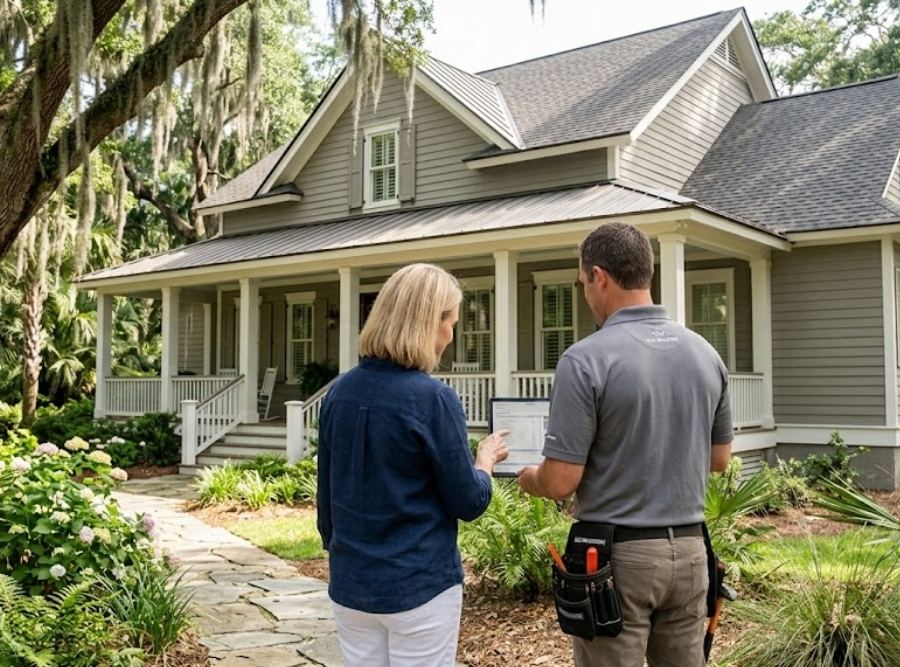
Ask who will personally inspect the roof and whether that person has the experience to explain what is failing and why. You should also ask whether the individual preparing the estimate will remain involved once the job begins or whether the project will be handed to people you have never met. Homeowners often discover too late that the knowledgeable salesperson disappears after the contract is signed, leaving a production manager or subcontracted crew to interpret a vague scope of work.
This question becomes particularly important on Hilton Head Island because the housing stock varies considerably. An original home in Sea Pines or Forest Beach may conceal decades of reroofing, repairs, additions, and modified flashing details. A custom residence in Wexford or Long Cove may have intersecting rooflines, walls, dormers, skylights, and specialty materials that require much more planning than a straightforward gable roof. Even homes of similar size can demand entirely different labor and detailing.
At Apex Roofing of the Lowcountry, Ralph or Pierce personally gets on the roof before an estimate is prepared. That owner involvement creates a direct connection between what is observed during the inspection, what is written into the proposal, and what the homeowner expects to happen during the project. Apex identifies itself as a licensed residential roofing contractor, a CertainTeed ShingleMaster certified contractor, and holder of South Carolina License #57706.
Make the Contractor Explain the Estimate Without Hiding Behind a Total
The most useful question you can ask about a roofing proposal is not, “Can you lower the price?” It is, “Can you walk me through exactly what this price includes and what could change after work begins?” A detailed answer allows you to compare actual scopes of work rather than comparing totals that may represent entirely different roofing systems.
The proposal should identify the roofing material, product line, underlayment, starter course, ridge or hip caps, flashing approach, ventilation work, drip edge, disposal, cleanup, permit responsibilities, and treatment of roof penetrations. It should also explain how damaged decking will be handled if deterioration is discovered after the existing roof is removed. Some decking damage cannot be confirmed until tear-off, but the process and pricing method for addressing it should not come as a surprise.
This is where unusually low estimates often begin to make sense. One contractor may plan to replace worn flashing while another assumes it can be reused. One may include manufacturer-specific starter shingles and ridge caps while another uses generic components. One may correct inadequate intake ventilation, protect landscaping, obtain permits, and document the installation, while another proposal says little beyond removing the old roof and installing new shingles.
A lower proposal is not automatically irresponsible, and a higher proposal is not automatically better. The concern is whether the scope is complete, understandable, and appropriate for the home. If the contractor cannot explain why a material or installation detail has been specified, the homeowner is being asked to buy a roofing system without being told what that system actually is.
Ask What Happens to Flashing, Ventilation, and the Parts You Cannot See
Shingles receive most of the attention because they cover the largest visible area of the roof, but many leaks begin where the roof changes direction or meets another surface. Chimneys, skylights, sidewalls, plumbing vents, valleys, dormers, and roof-to-wall intersections rely on carefully integrated flashing to direct water away from vulnerable openings. A proposal that describes the shingle brand in detail but says almost nothing about flashing leaves one of the most important parts of the installation unresolved.
Ask whether existing flashing will be inspected, reused, modified, or replaced. There is no single answer that applies to every component on every home, but the contractor should be able to describe the intended approach and explain why it is appropriate. On Hilton Head Island, salt-laden air and persistent humidity can accelerate corrosion, particularly on exposed metal and older flashing assemblies. Covering deteriorated details beneath new roofing may produce a roof that looks new while retaining the same leak vulnerability it had before replacement.
Ventilation deserves the same attention. Ask how the contractor evaluated attic intake and exhaust ventilation and whether the proposed system is balanced for the roof design. Simply adding a ridge vent does not guarantee proper airflow if soffit intake is blocked, undersized, or absent. Poor ventilation can contribute to trapped heat and moisture, shorten the service life of roofing components, and create attic conditions homeowners mistakenly attribute to a roof leak.
These questions quickly show whether the contractor is thinking about the complete roofing system or primarily selling the visible surface. A roof should not be reduced to shingles, color selections, and warranty brochures. Its long-term performance depends on how every layer and transition works together when Hilton Head’s rain is moving sideways rather than falling straight down.
Confirm Who Handles Permits and Community Approval Before Materials Are Ordered
Ask the contractor whether the project requires a Town of Hilton Head Island building permit, who will obtain it, and how you will confirm that the required inspections have been completed. The Town states that building permits are required for new construction and changes to existing buildings, and its online Citizen Self-Service system allows users to follow permitting and inspection activity. The Town also maintains contractor registration and licensing requirements for work performed within its jurisdiction.
A contractor who tells you permits are unnecessary should be willing to explain that conclusion based on the specific scope and current Town requirements. Homeowners should be cautious about accepting statements such as “we never pull permits for this” or “nobody checks roofing work here.” Avoiding a required permit may create problems during inspections, insurance reviews, warranty disputes, or a future sale.
For many Hilton Head properties, the Town permit is only part of the process. Sea Pines, Palmetto Dunes, Hilton Head Plantation, Port Royal Plantation, Shipyard, Wexford, Long Cove, Indigo Run, and other communities may have their own architectural review, contractor access, material, color, or scheduling requirements. Ask whether the contractor is familiar with the community and who will assemble samples, specifications, insurance documents, or other information needed for approval.
This is especially important for second-home owners who may be coordinating the project remotely. Materials should not arrive and crews should not be scheduled until the required approvals are understood. A contractor experienced with island communities should be able to anticipate these steps rather than discovering them after a delivery truck has been turned away at the gate.
Ask Whether the Crew Is Supervised or Simply Sent to the Address
Homeowners often interview one person and assume that person will oversee the work. Before signing, ask who will supervise the installation, how often that person will be present, and whom you should contact if a question arises during tear-off. You should understand whether the installers are company employees, subcontractors, or a combination, but the more important issue is accountability. Someone with authority and roofing knowledge should be responsible for confirming that the approved scope is followed.
Subcontracting is not automatically a sign of poor quality. Many capable roofing companies work with established crews that have installed their systems for years. Problems arise when the contractor cannot explain who will arrive, how workmanship is inspected, or who has authority to stop and correct work that does not meet the specification.
Ask what happens when unexpected conditions are uncovered. Older island homes may reveal rotten decking, previous leak repairs, inadequate flashing, or sections built differently from the rest of the structure. A responsible contractor should document the condition, explain the needed correction, and obtain approval through a written change order rather than making an unexplained addition to the final invoice.
The answer should make you feel that the project has been planned as a supervised construction job, not sold as a package and transferred to the lowest available crew. When the roof is open and coastal weather is approaching, the quality of project management matters just as much as the name printed on the shingle wrapper.
Ask What the Warranties Actually Cover—and Who Will Help If Something Goes Wrong
Roofing warranties are often described in broad terms that sound reassuring until a homeowner tries to understand what is actually covered. Before signing, ask the contractor to explain the difference between the manufacturer’s material warranty and the contractor’s workmanship warranty. These are not interchangeable, and neither should be summarized with a vague phrase such as “lifetime coverage.”
A manufacturer warranty generally addresses qualifying problems with the roofing product itself, subject to the manufacturer’s terms, exclusions, registration requirements, and installation standards. A workmanship warranty addresses installation-related issues, which are often the more immediate concern after a roof replacement. A premium shingle does not compensate for poorly integrated flashing, incorrect fastener placement, inadequate starter strips, or shortcuts around roof penetrations. The contractor should be able to explain how long its workmanship coverage lasts, what it includes, what it excludes, and how a homeowner begins a service request.
You should also ask who registers the manufacturer warranty and whether you will receive confirmation after the project is completed. A warranty that requires registration should not be left as an unspoken homeowner responsibility. At Apex Roofing, applicable manufacturer warranties are registered upon completion, and the homeowner receives the benefit of a process that does not end when the crew leaves the property.
The most revealing warranty question may be the simplest: “What happens if I notice a leak six months from now?” A trustworthy contractor should be able to describe how calls are handled, how quickly the concern is evaluated, and who makes the final determination about corrective work. The answer should sound like an established service process, not an improvised promise made at the kitchen table.
Make Sure the Weather Plan Is More Than “We Watch the Forecast”
Hilton Head roofing projects require careful weather planning because a clear morning can become a heavy afternoon downpour with very little warning. Ask how much of the roof the crew removes at one time, how exposed areas are protected, and what happens if weather changes after tear-off begins. The contractor should have a practical plan for keeping the structure watertight throughout the project rather than relying on optimism.
This question matters even more during hurricane season, when tropical forecasts can change quickly and materials, crews, disposal equipment, and community access must be coordinated carefully. A responsible contractor should not open more of the roof than the crew can safely protect before leaving for the day. Temporary coverings, underlayment installation, and end-of-day weatherproofing should be treated as fundamental responsibilities rather than emergency improvisations.
Homeowners should also ask what happens if the project is postponed. Does the contractor communicate directly with the owner or property manager? Are materials left on-site, and if so, how are they secured? How will the schedule be adjusted when several rain days affect multiple projects? Clear answers reveal whether the company has experience managing real coastal conditions rather than treating every roof as though it were being installed in predictable weather.
A contractor who takes weather protection seriously is thinking beyond production speed. The objective is not merely to remove and replace shingles quickly. It is to protect the home during every stage of the work, including the hours when the roof is most vulnerable.
Ask How Your Home, Landscaping, and Daily Routine Will Be Protected
Roof replacement is a construction project, and construction creates noise, debris, vibration, vehicle traffic, and repeated movement around the property. Before work begins, ask how the contractor will protect driveways, siding, windows, porches, landscaping, outdoor furniture, pools, and air-conditioning equipment. On Hilton Head Island, where many homes are surrounded by mature live oaks, carefully maintained plantings, narrow driveways, and community access restrictions, site planning deserves as much attention as the roof itself.
The contractor should explain where materials and disposal containers will be placed, how the crew will move debris from the roof, and what areas need to remain clear. Homeowners with pets, young children, rental guests, caretakers, or scheduled service providers should understand how the project may affect normal access to the home. For vacation properties, the contractor should discuss who will receive daily updates and how unexpected conditions will be communicated when the owner is not present.
Cleanup deserves a specific conversation rather than a generic promise that the property will be left “clean.” Roofing nails and small metal fragments can become hidden in grass, mulch, driveways, and planting beds during tear-off. Ask whether the contractor performs a magnetic sweep, how many times the property is checked, and whether gutters, patios, and surrounding surfaces are inspected before completion.
At Apex Roofing, replacement projects include a magnetic sweep after tear-off, along with photographic documentation and a final walkthrough. Those steps reflect a broader principle: the job is not complete simply because the new roof has been installed. The property should also be returned in a condition that demonstrates respect for the homeowner and the home.
Clarify the Payment Schedule Before the First Material Delivery
Payment terms should be understandable before any contract is signed. Ask how much is due initially, when additional payments are expected, what milestones trigger those payments, and whether the final balance is connected to completion of the agreed work. A contractor should be able to explain the schedule without creating pressure or ambiguity.
Be cautious when a proposal requires an unusually large upfront payment without a clear explanation of what the money covers. Deposits may be reasonable for material orders, specialty products, or project scheduling, but the amount and timing should correspond to the actual project plan. Homeowners should never feel that they are funding an undefined job before the contractor has documented the scope.
The contract should also explain how change orders are handled. Roof decking damage, concealed flashing problems, or structural deterioration may not become visible until the existing materials are removed. A professional process includes documenting the condition, explaining the correction, providing the associated price, and obtaining written approval. Unexpected work should not appear as an unexplained charge after the roof has already been completed.
Ask what forms of payment are accepted and whether final documents will be provided before the project is considered closed. Those documents may include the final invoice, warranty registration, permit or inspection records, photographs, and any approved change orders. A clear financial process protects both parties and reduces the likelihood of disagreements after construction ends.
Do Not Let an Insurance Claim Replace Your Own Contractor Questions
Storm damage can make contractor selection more confusing because homeowners may feel that the insurance company, adjuster, or claim itself will control every decision. Before hiring a roofer for insurance-related work, ask what role the contractor will play and what the company will not promise. A contractor may inspect the roof, document damage, prepare a repair estimate, and explain roofing conditions, but it should not guarantee claim approval or tell homeowners that “insurance will pay for everything.”
Ask how the contractor documents storm damage and whether photographs will clearly distinguish storm-related conditions from age, wear, or previous repairs. The estimate should describe the roofing work that is actually needed rather than simply mirror a claim total. If the contractor believes the insurance scope is missing legitimate roofing work, it should be able to explain those differences with documentation and practical roofing reasoning.
Homeowners should remain wary of anyone who applies immediate pressure after a named storm, offers to interpret the policy as though they control coverage, or treats an insurance payment as the project budget regardless of the roof’s needs. The contractor’s responsibility is to provide an accurate assessment and a clear scope of work. The insurance company determines coverage under the policy.
The right contractor should make the process easier to understand, not more confusing. You should finish the conversation knowing what damage was found, what work is recommended, what the estimate includes, and which questions still need to be addressed with your insurance agent or adjuster.
Ask How Communication Works When You Are Not on the Island
Hilton Head has a large number of second homes, vacation properties, rental homes, and residences managed by caretakers or property managers. If you will not be present throughout the project, ask exactly how updates will be provided. “We’ll keep you posted” is not a communication plan.
The contractor should explain who your primary contact will be, how often updates are sent, and whether photographs will document tear-off, decking conditions, flashing details, underlayment, installation progress, and final cleanup. Remote owners need enough information to understand what is happening without being forced to rely on occasional phone calls or wait until the project is finished.
You should also clarify who is authorized to approve unexpected work. If damaged decking is uncovered, will the contractor contact you directly, your property manager, or another designated representative? What happens if you are unavailable? Deciding these details in advance prevents unnecessary delays while the roof is open.
Photographic documentation is useful even when the homeowner lives in the house full time. Most people cannot safely inspect every stage of roofing work, and many critical components disappear beneath the finished surface. At Apex Roofing, photographs are used throughout the project so homeowners can see what was found and how the work progressed, not merely the final roof visible from the driveway.
Ask What “Finished” Means Before the Project Begins
A contractor’s definition of completion should include more than installing the last ridge cap. Ask whether the project includes a final inspection, homeowner walkthrough, cleanup review, warranty registration, and resolution of any remaining punch-list items. The answer reveals whether the company sees completion as the end of production or the end of its responsibility to the homeowner.
A final walkthrough gives both parties an opportunity to review the work, discuss any changes that occurred, and confirm that the property has been cleaned. It should also give the homeowner a chance to ask about future maintenance, attic observations, ventilation concerns, or areas that should be monitored over time.
Permits and required inspections should be closed out rather than left unresolved. Warranty documents should be delivered or confirmed, and the homeowner should know whom to contact if a question appears after the next heavy rain. These details may feel administrative compared with shingles and flashing, but they are often what determine whether the project ends with confidence or uncertainty.
A contractor who carefully defines completion before beginning the job is less likely to disappear once the major work is done. That matters because the best roofing relationships are not built around a single transaction. They are built when homeowners know exactly whom to call after the next storm, during the next inspection, or when a friend asks for a roofing recommendation.
The Best Contractor Is the One Who Makes the Entire Project Easier to Understand
Choosing a roofing contractor in Hilton Head should not come down to selecting the smoothest salesperson, the most familiar logo, or the lowest number at the bottom of an estimate. The better decision comes from understanding who inspected the roof, what the contractor found, what the proposed system includes, how the property will be protected, and who remains accountable after the final payment.
The most trustworthy answers are usually specific. They identify materials rather than referring vaguely to “premium shingles.” They explain flashing rather than assuming it will work itself out during installation. They describe permits, supervision, cleanup, weather planning, change orders, warranties, and communication in language a homeowner can follow. A contractor who takes time to answer these questions before the project is more likely to maintain that same level of care once the roof is open.
For Hilton Head homeowners, that thoroughness is not an unnecessary luxury. Coastal roofs face salt air, high humidity, intense sunlight, tropical weather, and wind-driven rain that quickly expose weak details. Vacation ownership, community approval requirements, complex custom homes, and remote project coordination make clear planning even more important.
Apex Roofing of the Lowcountry approaches the process as a long-term relationship rather than a one-time sale. Ralph or Pierce personally inspects the roof, homeowners receive an itemized written estimate, materials are not ordered until the work is approved in writing, and the project is documented from inspection through completion. Required permits are coordinated, replacement projects receive a magnetic sweep, applicable manufacturer warranties are registered, and a final walkthrough occurs before the job is called finished.
The questions you ask before hiring a roofing contractor may take an extra hour now, but they can prevent years of uncertainty later. If you are comparing roofing estimates in Hilton Head Island, Apex Roofing can inspect the roof, explain what it actually needs, and provide a clear proposal without pressure. The objective is not simply to help you choose a contractor. It is to help you understand the project well enough to recognize when it is being handled correctly.